Agentic AI for Business in 2026: How AI Agents Work, Where They Pay Off, and Why Many Projects Fail
· @Nishant
Agentic AI is software that plans and carries out multi-step work on its own, using your company’s tools and data. Analysts expect it to be in nearly half of business software by the end of 2026, yet they also expect many projects to be cancelled. This guide explains how AI agents work, where they deliver value, what goes wrong, and how to roll them out safely.
What is agentic AI?
Generative AI answers a prompt. Agentic AI is given a goal and works toward it: it breaks the goal into steps, calls tools, checks the results and tries again if something fails. One 2026 industry report defines it as software in which autonomous or semi-autonomous agents plan and execute multi-step work across tools and systems.
The easiest way to see the difference is to compare three levels of AI.
Type | What it does | Who is in control | Example |
|---|---|---|---|
Chatbot | Answers questions from a prompt | The user, every step | Asking for a policy summary |
Copilot | Suggests or drafts inside an app | The user approves each action | Drafting a reply in your inbox |
AI agent | Pursues a goal across several tools | The agent, within set limits | Resolving a refund request end to end |
How an AI agent works
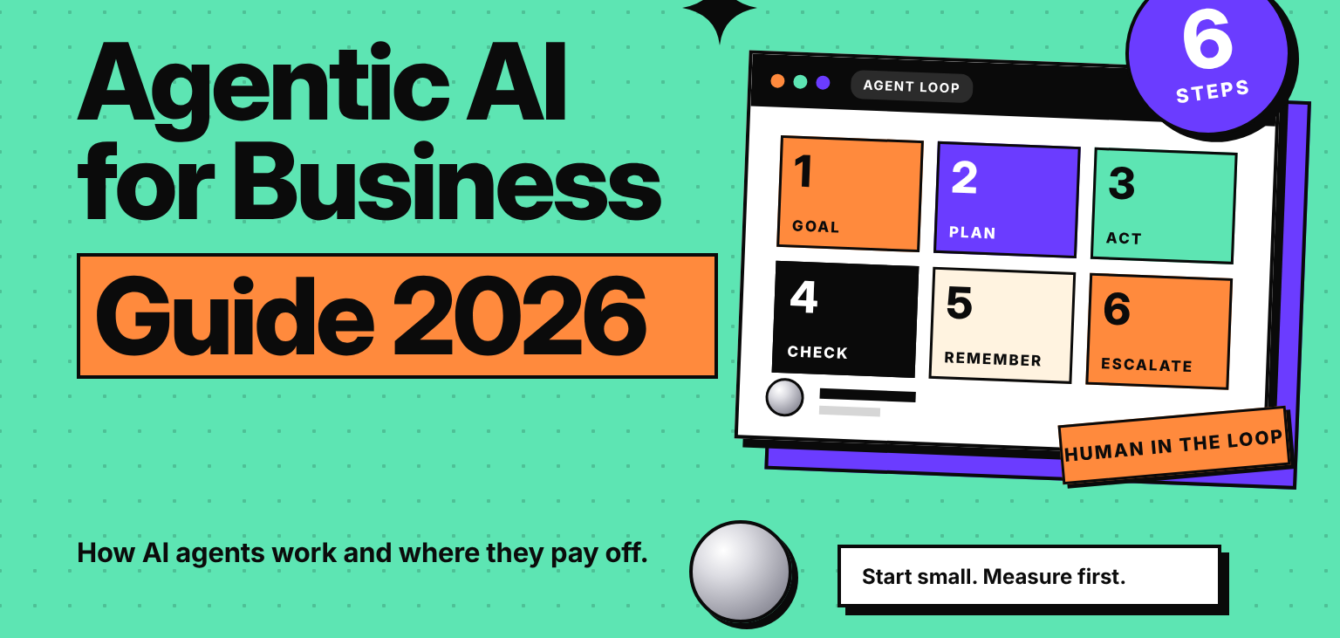
Most business agents follow the same loop, and each part is a place where things can break.
- Goal. A person or a trigger gives the agent a task and the rules it must follow.
- Plan. The model breaks the task into steps and chooses which tools to use.
- Act. The agent calls tools such as a CRM, a database, an email system or an internal API.
- Check. It reviews the result, fixes mistakes and decides whether to continue.
- Remember. It keeps context from earlier steps so it does not repeat work.
- Escalate. When something falls outside its scope, it hands the case to a human.
The last step matters most for safety. One 2026 analysis of enterprise adoption stresses having an escalation path when agents meet conditions outside their defined scope.
Where businesses use AI agents
- Customer service. Gartner reportedly expects 80% of customer service organizations to apply generative and agentic AI by the end of the year, as summarised by Keyhole Software.
- IT operations. A Gartner survey reported by CIO Pulse found 60% of enterprises piloting or scaling agent automation in IT infrastructure.
- Supply chain. Gartner forecasts supply chain software with agentic AI growing from under $2 billion in 2025 to $53 billion in yearly spend by 2030, per Enterprise DNA.
- Sales, finance and HR. Agents that qualify leads, match invoices or screen applications follow the same pattern: repetitive work with clear rules and a human reviewing exceptions.
The adoption gap: hype versus reality
The headline numbers look huge, but they describe different things. Gartner predicts 40% of enterprise applications will include task-specific AI agents by the end of 2026, up from under 5% in 2025. Yet surveys of real production use are far lower. Deloitte’s 2025 research, quoted by Keyhole Software, put organizations actively using agents in production at about 11%, with 38% piloting.
The figures disagree because “adoption” is defined differently in each survey. A company that bought software with an agent feature counts in one study. A company running an agent in production counts in another. When you read a statistic, check which definition it uses.
Why AI agent projects fail
The same Gartner research that predicts rapid growth also warns that over 40% of agentic AI projects will be cancelled by the end of 2027, driven by rising costs, unclear business value and weak risk controls.
Four causes come up again and again:
- No clear business case. Teams start with the technology instead of a measurable problem.
- Poor data. One aggregated enterprise survey lists data quality as the top blocker, cited by roughly half of organizations (approximate).
- Weak governance. Only around a fifth of organizations are reported to have a mature agent governance model (approximate, from the same aggregation).
- Agent sprawl. An OutSystems survey of 1,900 IT leaders found 94% concerned that growing numbers of agents are creating complexity and risk.
A practical rollout plan
Teams that reach production tend to start small and measure early.
- Pick one narrow workflow. Choose repetitive work with clear rules, such as refund requests or invoice matching.
- Set a baseline. Record current time, cost and error rate before the agent touches anything.
- Limit permissions. Give the agent only the tools and data the task needs, with read-only access first.
- Keep a human in the loop. Require approval for high-risk actions like payments or customer-facing messages.
- Log everything. Record each step so you can audit decisions and debug failures.
- Measure against the baseline. Scale only if cost, speed or quality improves.
- Standardize before you multiply. Agree on shared rules and a registry of agents before teams build their own.
AI agent governance checklist
- Every agent has a named owner and a documented purpose.
- Permissions follow least privilege, reviewed regularly.
- Sensitive actions need human approval.
- All actions are logged and reviewable.
- Agents can be paused or shut off quickly.
- Rules for personal data and regulated information are written down and tested.
- Agents are tested against edge cases before launch and after every major change.
Frequently asked questions
What is agentic AI in simple terms? AI that is given a goal and completes the steps itself, using tools and data, instead of only answering a question.
What is the difference between generative AI and agentic AI? Generative AI produces content when asked. Agentic AI acts toward a goal across several steps and tools.
Are AI agents ready for business use? For narrow, well-defined tasks with human oversight, yes. Broad, unsupervised use is still risky and often fails to show clear value.
How much do AI agents cost? Costs depend on the model, usage and integration work. Rising costs are one of the main reasons Gartner expects projects to be cancelled, so budget for monitoring and maintenance, not only the build.
Will AI agents replace jobs? Today they mostly take over repetitive tasks and leave exceptions and judgment to people. Roles are shifting more than disappearing, but this varies by industry.
The bottom line
Agentic AI is moving from experiments into real business software, but adoption claims run well ahead of production results. The companies that benefit will be the ones that choose one clear problem, control what agents can do, and measure the outcome before they scale.