A website in 2026 needs to do much more than look professional. It needs to attract the right visitors, answer their questions, understand what they are looking for, and guide them toward becoming customers.
Artificial intelligence is making all of this easier.
Businesses can now use AI to improve website content, automate repetitive marketing tasks, analyze visitor behavior, generate leads, personalize customer experiences, and provide instant support. AI website optimization is increasingly becoming a combination of content, SEO, automation, analytics, personalization, and customer experience rather than simply using AI to generate text.
The goal, however, is not to install every AI tool available. The smarter approach is to identify where your website is losing opportunities and use AI to solve those specific problems.
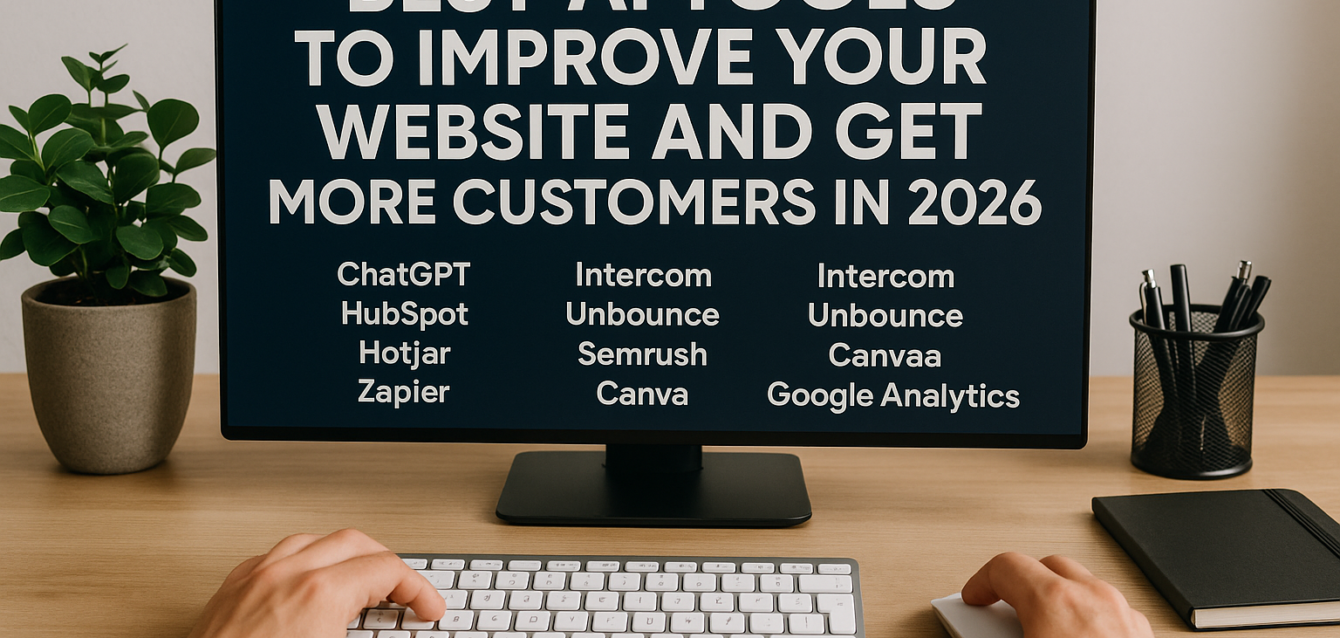
Here are some of the best AI tools to improve your website and get more customers in 2026.
1. ChatGPT – Improve Website Content and Marketing Ideas
[ChatGPT](https://chatgpt.com/?utm_source=chatgpt.com) has become one of the most versatile AI tools businesses can use for website improvement.
Instead of using it only for writing blog posts, businesses can use ChatGPT to analyze and improve almost every part of their website.
For example, you can paste your homepage content into ChatGPT and ask it to identify unclear messaging, weak value propositions, missing customer benefits, or opportunities to strengthen calls to action.
It can also help with:
Website headlines and subheadings
Product and service descriptions
Landing page content
FAQs
Email campaigns
Customer personas
Content ideas
SEO content planning
Social media campaigns
The quality of the result depends heavily on the information and instructions you provide. Instead of asking AI to “improve my website,” provide your target customer, service, business goal, current copy, and the action you want visitors to take.
AI then becomes a strategic assistant rather than simply a content generator.
2. HubSpot – Turn Website Visitors Into Leads
[HubSpot](https://www.hubspot.com/?utm_source=chatgpt.com) is particularly useful when your biggest problem is not getting traffic but turning website visitors into leads and customers.
HubSpot combines CRM, marketing automation, website tools, lead management, analytics, and AI capabilities.
Its AI capabilities can assist with content creation, customer information, campaign analysis, and marketing workflows. HubSpot has also expanded into Answer Engine Optimization (AEO), helping businesses understand and improve their visibility across AI-powered discovery platforms.
This matters because customer discovery is changing. HubSpot reported in 2026 that 42% of surveyed CRM buyers used AI search during evaluation, and those users were 36% more likely to purchase than buyers who did not use AI search.
Businesses can use HubSpot to create a connected journey:
Website Visitor → Form Submission → CRM → Automated Follow-Up → Qualified Lead → Sales Conversation
Instead of leads disappearing into an inbox, automation can make sure every enquiry receives the right follow-up.
3. Hotjar – Understand What Visitors Actually Do
You may think you know how people use your website, but real visitor behavior can tell a very different story.
[Hotjar](https://www.hotjar.com/?utm_source=chatgpt.com) helps businesses understand how visitors interact with pages through tools such as heatmaps, recordings, surveys, and behavioral insights.
This can reveal problems that traditional analytics might not make obvious.
For example, visitors may repeatedly click an element that isn’t clickable. They may stop scrolling before reaching your main CTA. Mobile visitors might struggle with a form. Or users may repeatedly abandon the same section.
Instead of redesigning a website based on assumptions, you can use actual behavioral information to prioritize improvements.
4. Zapier – Automate What Happens After Someone Visits Your Website
[Zapier](https://zapier.com/?utm_source=chatgpt.com) can connect your website with the applications your business already uses.
Imagine someone downloads a guide from your website.
Without automation, someone might need to manually copy their information into a CRM, notify sales, add them to an email platform, and create a follow-up task.
With automation, those actions can happen automatically.
A workflow could look like:
Website Form → CRM → Email Sequence → Sales Notification → Follow-Up Task
The real benefit of AI automation is therefore not simply saving a few minutes. It helps create a consistent system where fewer opportunities are forgotten.
5. Surfer – Improve SEO Content With AI
Creating content is easy. Creating content that attracts relevant visitors is much harder.
[Surfer](https://surferseo.com/?utm_source=chatgpt.com) helps businesses optimize website and blog content using search data and AI-assisted recommendations.
It can help analyze factors such as topic coverage, content structure, related terms, and on-page optimization.
For businesses investing heavily in content marketing, this can make the process more systematic.
The important thing is to avoid blindly following optimization scores. Your content still needs original expertise, useful examples, strong writing, and genuine value.
AI should improve human-created content rather than turn your website into hundreds of generic articles.
6. Intercom – Provide AI-Powered Customer Support
Visitors often leave websites because they cannot quickly find an answer.
Pricing questions, product questions, service availability, integrations, delivery information, and technical questions can all create friction.
[Intercom](https://www.intercom.com/?utm_source=chatgpt.com) provides AI-powered customer support capabilities that can answer questions using a company’s support content and knowledge base.
AI customer service tools have become an important category in 2026, with platforms increasingly combining conversational AI with existing knowledge and support systems.
For businesses receiving large numbers of repetitive enquiries, this can reduce response times while allowing human support teams to concentrate on conversations that genuinely require personal attention.
7. Unbounce – Build and Improve Landing Pages Faster
Getting people to your website is only half the challenge. The page they land on needs to convince them to act.
[Unbounce](https://unbounce.com/?utm_source=chatgpt.com) is designed around landing page creation and optimization.
Businesses can use landing pages for:
Paid advertising campaigns
Lead-generation offers
Product launches
Webinar registrations
Free consultations
Downloads and gated content
Instead of sending every advertising campaign to the homepage, businesses can build focused pages around individual offers and customer segments.
AI-assisted copywriting and optimization can also accelerate experimentation, allowing marketing teams to create and test variations more efficiently.
8. Semrush – Find More Opportunities to Attract Customers
[Semrush](https://www.semrush.com/?utm_source=chatgpt.com) can help businesses understand how customers discover them through search and where competitors may have an advantage.
It combines keyword research, competitor research, technical SEO, content tools, and increasingly AI-search visibility features.
That last area is becoming particularly important.
Customers are no longer discovering businesses exclusively through traditional Google results. They are also asking AI assistants for product recommendations, comparisons, service providers, and answers.
As a result, businesses in 2026 need to think about both traditional SEO and visibility within AI-generated answers. Tools are increasingly being developed specifically to track this new form of brand discoverability.
9. Canva AI – Create Better Website Visuals Faster
Website improvement isn’t limited to text and analytics.
Poor graphics, inconsistent branding, outdated banners, and low-quality marketing visuals can reduce the perceived credibility of a business.
[Canva](https://www.canva.com/?utm_source=chatgpt.com) provides AI-assisted tools that make it easier to produce graphics, presentations, social media assets, marketing materials, and visual content.
This is particularly useful for smaller businesses that do not have a dedicated designer available for every campaign.
AI can accelerate production, but businesses should still maintain consistent fonts, colors, imagery, and visual hierarchy across their website.
10. Google Analytics – Combine Website Data With Smarter Analysis
[Google Analytics](https://analytics.google.com/?utm_source=chatgpt.com) remains essential because AI recommendations are only useful when you can measure whether changes actually improve business performance.
Monitor metrics such as:
Traffic sources
Landing page engagement
Form submissions
Purchases
Lead generation
User journeys
Campaign performance
Instead of looking only at total website traffic, focus on the visitors and pages that generate meaningful business outcomes.
A website receiving 5,000 highly relevant visitors can be far more valuable than one receiving 50,000 visitors who never enquire or purchase.
How to Build a Practical AI Website Stack
You do not need ten AI subscriptions to improve your website.
Start with the biggest problem.
If you aren’t attracting enough relevant visitors, concentrate on SEO, content, and AI search visibility.
If visitors arrive but don’t take action, concentrate on landing pages, behavioral analytics, messaging, and conversion optimization.
If you generate leads but struggle to follow up, concentrate on CRM and marketing automation.
If your team spends hours answering repetitive questions, implement AI customer support.
A simple stack could be:
ChatGPT → Content and research
Semrush or Surfer → Search optimization
Hotjar → Visitor behavior
HubSpot → CRM and lead management
Zapier → Workflow automation
Intercom → Customer support
The best AI stack is not the one with the most tools. It is the one where each tool solves a measurable business problem.
AI Should Improve the Customer Journey, Not Complicate It
The biggest mistake businesses can make in 2026 is adopting AI simply because competitors are using it.
Start with the customer journey.
Ask where people struggle to discover your company, understand your offer, trust your business, contact your team, or complete a purchase.
Then use AI to remove those barriers.
AI can help businesses research faster, create better content, automate lead management, understand visitor behavior, personalize experiences, and respond to customers around the clock.
But strategy still matters.
The businesses that benefit most from AI will not necessarily be those using the largest number of tools. They will be the ones connecting AI with a clear website strategy, useful content, good user experience, and effective customer acquisition systems.
In 2026, your website should no longer function as a digital brochure.
With the right combination of AI and automation, it can become an active system for attracting visitors, understanding their needs, generating leads, nurturing prospects, and turning more of them into customers.
AI & Automation Keywords
AI website optimization, AI automation tools, AI marketing automation, AI tools for business, AI website tools, AI customer acquisition, website automation, AI lead generation, AI-powered marketing, automated lead nurturing, AI customer service, AI SEO tools, AI workflow automation, AI chatbot for website, AI conversion optimization