What Is A/B Testing?
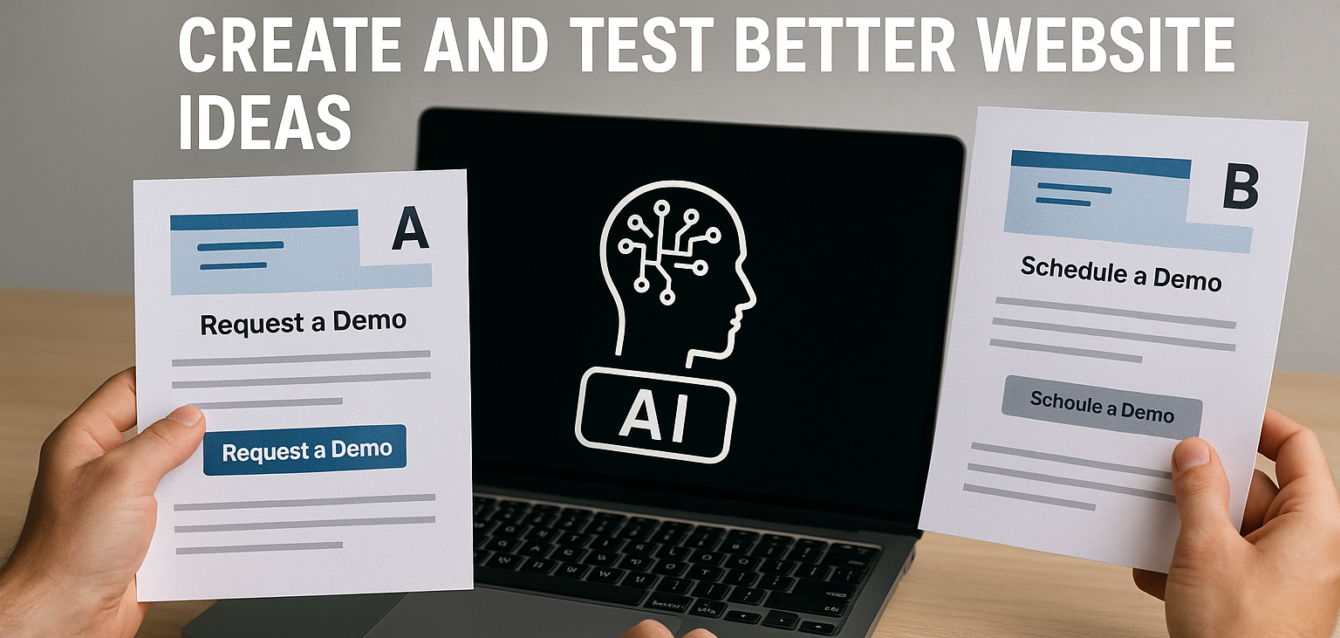
A/B testing is a controlled experiment in which visitors are randomly shown different versions of a webpage. Version A is usually the existing page, while Version B contains a change you want to evaluate. Both versions run during the same period, and their performance is compared against a defined goal.
For example, you might test whether a benefit-focused headline generates more demo requests than your current headline.
The important part is that you’re not asking, “Which version looks better?”
You’re asking, “Which version helps more visitors complete the action we care about?”
1. Use AI to Find Testing Opportunities
Before generating new designs, identify where your website may be losing customers.
AI can help review analytics exports, customer feedback, survey responses, support conversations, and landing-page content to identify recurring problems.
You might ask:
“Review these landing-page metrics and customer comments. Identify the three most likely reasons visitors aren’t submitting the form. Separate observations from hypotheses.”
That last instruction matters. AI should distinguish what the data actually shows from what it merely suspects.
For example, analytics may show that mobile visitors abandon a form more frequently. AI might suggest that the form is too long, but that explanation still needs investigation.
AI helps you find where to look. It doesn’t automatically prove why something is happening.
2. Turn Problems Into Clear Hypotheses
A useful A/B test starts with a specific hypothesis.
Instead of:
“Let’s make the landing page better.”
Try:
“Changing the headline to explain the primary customer benefit will increase demo requests because visitors will understand the offer more quickly.”
This gives you three things: the change, the expected outcome, and the reasoning.
AI can help turn vague observations into testable hypotheses. It can also challenge your assumptions by suggesting alternative explanations.
For example, if visitors aren’t clicking your CTA, the problem might be the button text. But it could also be the offer, the surrounding copy, or insufficient trust.
The goal is to test a meaningful idea not simply generate another design variation.
3. Generate Better Headlines and Copy
One of AI’s most practical uses in A/B testing is creating copy variations.
Suppose your current headline says:
“The Future of Business Automation.”
AI could help develop alternatives focused on different customer motivations:
Benefit-focused: “Automate Repetitive Work and Give Your Team More Time.”
Problem-focused: “Stop Losing Hours to Manual Business Processes.”
Outcome-focused: “Turn Repetitive Tasks Into Reliable Automated Workflows.”
These are not guaranteed winners. They’re different messaging hypotheses.
A strong prompt should include your target audience, product, primary benefit, customer objections, brand tone, and conversion goal.
The more relevant context you provide, the more useful the variations become.
Then let actual visitors determine which message performs better.
4. Test Calls to Action
AI can also help improve CTA ideas.
A generic button such as “Learn More” might be appropriate for an educational page, but it may not clearly communicate the next step on a high-intent landing page.
You could test:
“See How It Works”
Against:
“Book a Free Demo”
Or:
“Submit”
Against:
“Get My Free Website Audit”
The important question is whether the CTA matches visitor intent.
AI can generate alternatives, but your test should measure the action that matters. A button receiving more clicks doesn’t necessarily mean more qualified leads or sales.
5. Explore Layout and Design Variations
AI can accelerate early design exploration by suggesting alternative page structures, content hierarchy, visual directions, and ways to present information.
For example, you might test:
A product screenshot versus a customer-focused hero image.
A short form versus a longer form.
A testimonial near the CTA versus one farther down the page.
A pricing comparison versus a simpler offer explanation.
However, avoid changing everything at once unless you’re intentionally testing a complete page concept.
If you change the headline, image, CTA, form, and layout simultaneously, you may discover which page performs better but you won’t know which individual change caused the difference.
Focused tests are generally easier to interpret.
6. Prioritize Ideas Before Testing
AI can generate 50 ideas in seconds.
That doesn’t mean you should test all 50.
Prioritize ideas based on potential impact, confidence, and effort.
For example, fixing an unclear offer on a high-traffic landing page may be more valuable than testing a minor icon change.
A useful prioritization question is:
“If this hypothesis is correct, how much could it improve the customer journey?”
AI can help organize and score ideas, but the final priority should reflect your business goals, available traffic, development resources, and customer evidence.
7. Set Up the Experiment Properly
Once you’ve chosen a hypothesis, use an experimentation platform to create the variations, define the audience, allocate traffic, and measure the outcome.
For example, can be used to interpret experiment results when integrated with a third-party A/B testing tool.
Before launching, decide on your primary metric.
For an ecommerce page, that might be purchases.
For a SaaS landing page, it might be trial signups.
For a service business, it might be qualified consultation requests.
You can also track secondary metrics, but avoid declaring success simply because one interesting number improved.
8. Let the Test Collect Enough Data
This is where many businesses make mistakes.
Version B gets three conversions on the first day, while Version A gets one.
Someone announces:
“B is the winner!”
Not so fast.
Small samples can produce misleading results. Before launching, estimate the sample size needed to detect a meaningful improvement, and follow the statistical method used by your experimentation platform.
Don’t stop a conventional fixed-horizon test early just because the numbers look exciting. Some sequential testing methods support continuous monitoring, but that depends on the platform’s statistical approach.
AI can help explain the results, but it shouldn’t invent statistical confidence or declare a winner without sufficient evidence.
9. Use AI to Analyze What Happened
After the experiment, AI can help summarize the results and identify possible lessons.
For example:
“Compare these two variations using conversion rate, revenue, device breakdown, and traffic source. Explain what the results support, what remains uncertain, and what we should test next.”
This is especially useful when different visitor segments behave differently.
Perhaps the new headline performs better on mobile but not desktop.
Perhaps more visitors click the CTA, but fewer complete the form.
Perhaps conversion rate improves while average order value declines.
AI can help surface these patterns, but human judgment is needed to decide what they mean for the business.
10. Build a Continuous Testing Process
The biggest benefit of AI isn’t that it creates one winning headline.
It’s that it can make experimentation easier to repeat.
Your workflow becomes:
Analyze → Hypothesize → Generate → Test → Measure → Learn → Repeat
Over time, you build a better understanding of your customers.
You learn which messages resonate, which objections matter, which layouts reduce friction, and which offers motivate action.
And importantly, you learn what doesn’t work.
A failed test isn’t necessarily wasted effort. It can prevent you from making a larger, more expensive mistake.
AI Makes Testing Faster. Customers Decide What Works.
AI can generate ideas, accelerate copywriting, suggest design variations, organize hypotheses, and summarize experiment results.
But it cannot guarantee that a particular headline, CTA, or layout will increase conversions.
Your customers make that decision through their behavior.
The strongest approach combines AI-powered speed with human strategy and real experimentation.
Use AI to explore more intelligently.
Use A/B testing to validate.
Use business results to decide what stays.
Because the goal isn’t to create more website variations.
It’s to discover which changes actually help more visitors become customers.
#AIA/Btesting #AIwebsiteoptimization #A/Btestingtools #conversionrateoptimization #AICROtools #landingpageA/Btesting #websiteexperimentation #AIlandingpageoptimization #conversiontesting #AImarketingtools #websiteconversionoptimization #A/Btestingstrategy #AIcopywritingforwebsites #splittesting #AI-poweredCRO