Website traffic has limited value if visitors leave without buying, booking, signing up, or requesting a quote. Website conversion rate optimization focuses on turning more of your existing traffic into measurable business results.
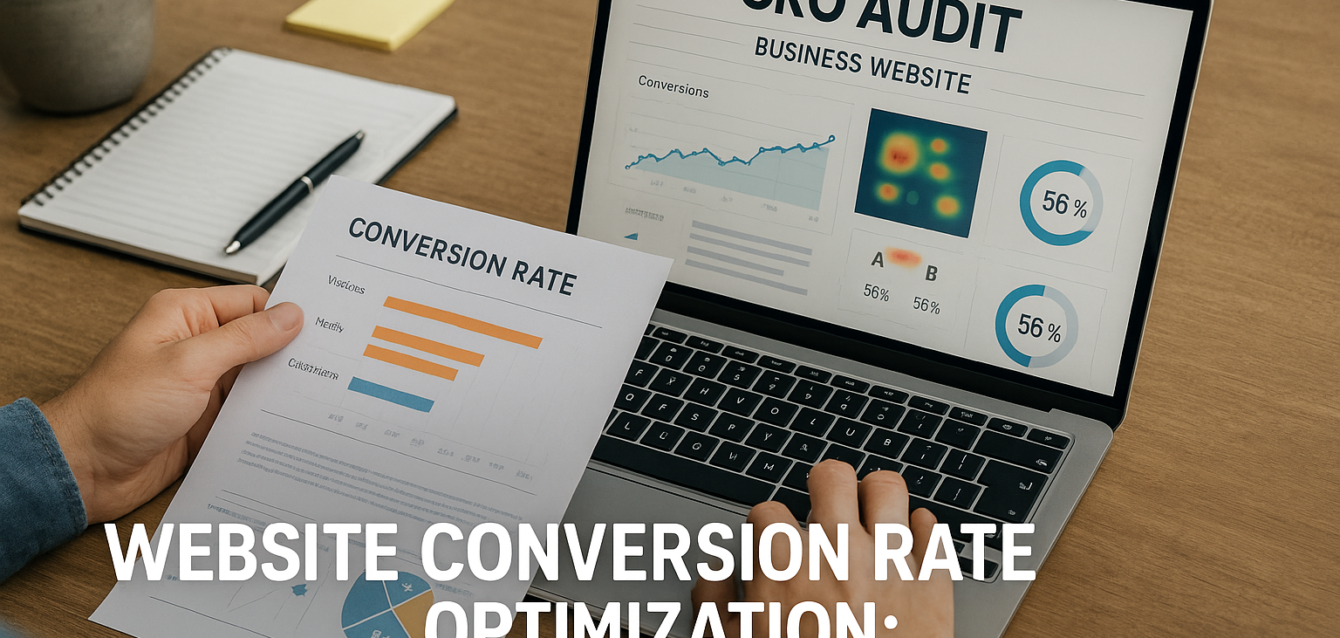
CRO works by studying user behavior, identifying friction in the conversion funnel, and testing improvements that make the next step easier. Before spending more on advertising, businesses can start with a free CRO audit to uncover problems with messaging, calls to action, forms, mobile usability, page speed, and trust signals.
In our analysis of 200+ landing pages, we found that common conversion opportunities appeared around unclear value propositions, weak message match, hidden CTAs, unnecessary form friction, and insufficient social proof.
Improving a conversion rate from 3% to 4% generates roughly 33% more conversions from the same amount of traffic.
What Is Website Conversion Rate Optimization?
Website conversion rate optimization is the process of improving a website so a higher percentage of visitors complete a desired action. That action may be an ecommerce purchase, lead form submission, trial signup, consultation booking, or another business goal.
The basic formula is:
Conversions ÷ Visitors × 100 = Conversion Rate
If 100 people convert from 5,000 visitors, the conversion rate is 2%. If optimization increases conversions to 150 without increasing traffic, the rate rises to 3%.
CRO differs from SEO and paid advertising because those channels primarily focus on attracting visitors. Website CRO focuses on what happens after those visitors arrive.
A strong conversion rate optimization strategy considers message match, above-the-fold content, call to action placement, page speed, mobile optimization, social proof, trust signals, and conversion funnel friction.
How Website Conversion Rate Optimization Works
Effective CRO uses research and testing rather than assumptions. The goal is to identify why visitors hesitate, then improve the parts of the experience most likely to influence their decision.
At The Dreamer Designs, we use the Dreamer Designs 8-Point CRO Audit Framework to review the most important areas of landing page and website performance.
Define a Clear Conversion Goal
Every CRO project needs one primary goal. Without it, businesses risk optimizing clicks and interactions that do not contribute to revenue.
An ecommerce website may prioritize completed purchases, while SaaS companies may focus on free-trial signups or demo requests. Service businesses may measure qualified leads.
Supporting metrics can include click-through rate, form completion, bounce rate, lead quality, and revenue per visitor.
Before making changes, confirm that Google Analytics 4 is tracking the desired conversion correctly. Your CRO efforts should be evaluated against business outcomes, not design preferences.
Strengthen Above-the-Fold Messaging
Visitors should quickly understand what you offer, why it matters, and what they should do next.
Message match is especially important for paid campaigns. If an ad promises a free website conversion audit, the landing page should reinforce the same offer rather than start with generic company messaging.
Headline testing can compare benefit-focused, problem-focused, and outcome-focused copy. Your CTA should also communicate value. “Get My Free Audit” is clearer than a generic button such as “Submit.”
For campaigns that need a focused journey, a professional landing page can reduce distractions and keep attention on one conversion goal.
Reduce Conversion Funnel and Form Friction
Conversion friction is anything that makes the desired action harder than necessary. It may appear in long forms, confusing navigation, complicated checkout steps, unclear pricing, or excessive information requests.
Form friction is particularly common. A visitor requesting an initial consultation may not need to provide company revenue, budget, address, job title, and several written answers before speaking with someone.
Review every form field and ask whether the information is truly necessary at that stage.
For Shopify and other ecommerce websites, also examine product information, shipping details, payment options, returns, and checkout steps. Good ecommerce conversion optimization reduces unnecessary effort while preserving the information customers need to make a confident decision.
Add Trust Signals and Social Proof
Visitors need evidence that supports your claims. Trust signals reduce uncertainty near important conversion points.
Useful proof includes testimonials, client logos, reviews, case study results, ratings, guarantees, certifications, and security information.
Specific social proof is usually stronger than generic praise. A testimonial describing a problem solved and a measurable result is more persuasive than simply saying, “Great company.”
Place relevant trust signals close to forms, pricing, and CTAs where visitors are making decisions. According to CXL, CRO should be driven by research and experimentation rather than blindly applying generic best practices.
Improve Page Speed and Mobile Optimization
Page speed and mobile usability directly influence the visitor experience. Slow loading, unstable layouts, oversized images, or difficult mobile forms can create friction before someone evaluates your offer.
Use Google PageSpeed Insights to review performance and core web vitals. Common problems include oversized images, heavy scripts, layout shifts, and unnecessary third-party integrations.
Mobile optimization requires more than shrinking the desktop design. Check button sizes, text length, form spacing, sticky elements, and CTA visibility on real devices.
A high bounce rate does not automatically mean speed is the problem, but poor performance should be investigated alongside user behavior and conversion data.
Use Behavioral Data Before Redesigning
Analytics shows what visitors did. Heatmaps and session recordings can provide context about why they behaved that way.
A heatmap may reveal that users rarely reach an important CTA. A session recording may show repeated clicks, form hesitation, or interaction with elements that are not actually clickable.
Microsoft provides heatmaps and session recordings that can support this research.
The goal is not to collect more data for its own sake. Every observation should lead to a useful hypothesis. If visitors repeatedly abandon the same form field, investigate that field before redesigning the entire page.
Use A/B Testing to Validate Improvements
A/B testing compares a control page with a variation to determine whether a specific change improves performance.
High-value testing opportunities include headlines, CTA wording, form length, hero imagery, social proof, trust signals, and offer positioning.
Every experiment should begin with a clear hypothesis. For example: “Reducing the form from seven fields to four will increase submissions because the process will feel easier.”
Split testing can compare substantially different page concepts, while multivariate testing examines combinations of several variables and generally requires more traffic.
A strong CRO strategy is not about running as many experiments as possible. It is about testing changes that answer meaningful business questions.
Common CRO Mistakes That Reduce Conversions
Most CRO mistakes happen when businesses make changes without enough evidence.
Redesigning before diagnosing the problem can produce a better-looking website with the same conversion weaknesses. Testing cosmetic changes first can also waste traffic that could have been used to evaluate stronger headlines, offers, forms, or CTAs.
Changing too many elements at once makes it difficult to understand why one variation performed better. Similarly, relying too heavily on a conversion rate benchmark can be misleading because industry, traffic source, audience intent, pricing, and conversion type all influence performance.
Businesses should also measure lead quality. More conversions do not necessarily mean more revenue if those leads never become customers.
CRO Tools That Help Find Conversion Opportunities
Different CRO tools answer different questions, so combining them usually produces stronger insights.
Start with The Dreamer Designs CRO analyzer to identify landing page and website conversion opportunities. Use Google PageSpeed Insights for page speed and core web vitals, Microsoft Clarity for heatmaps and session recordings, and Google Analytics 4 for conversion tracking and traffic analysis.
A full CRO dashboard can help connect these findings and keep optimization focused on measurable business outcomes.
Turn More Website Traffic Into Business Results
Website conversion rate optimization helps make existing traffic more valuable. Instead of depending only on more ads, more content, or more visitors, CRO improves the experience between arrival and conversion.
Focus first on clear messaging, strong message match, visible calls to action, relevant social proof, fast mobile experiences, and lower form friction. Then use A/B testing, heatmaps, session recordings, and analytics to identify the next improvement.
Before redesigning or launching experiments,run a free audit to find your highest-impact conversion opportunities. If your campaigns need a more focused experience, our landing page design service can turn those insights into a custom page built around measurable growth.
#Websiteconversionrateoptimization #Conversionrateoptimization #CROoptimization #WebsiteCRO #Websiteconversionoptimization #CROaudit #CROanalyzer #Conversionrateoptimizationstrategy #LandingpageCRO #CROtools #Conversionfunneloptimization #Ecommerceconversionoptimization #A/Btesting #CRObestpractices #Conversionrateoptimizationservices