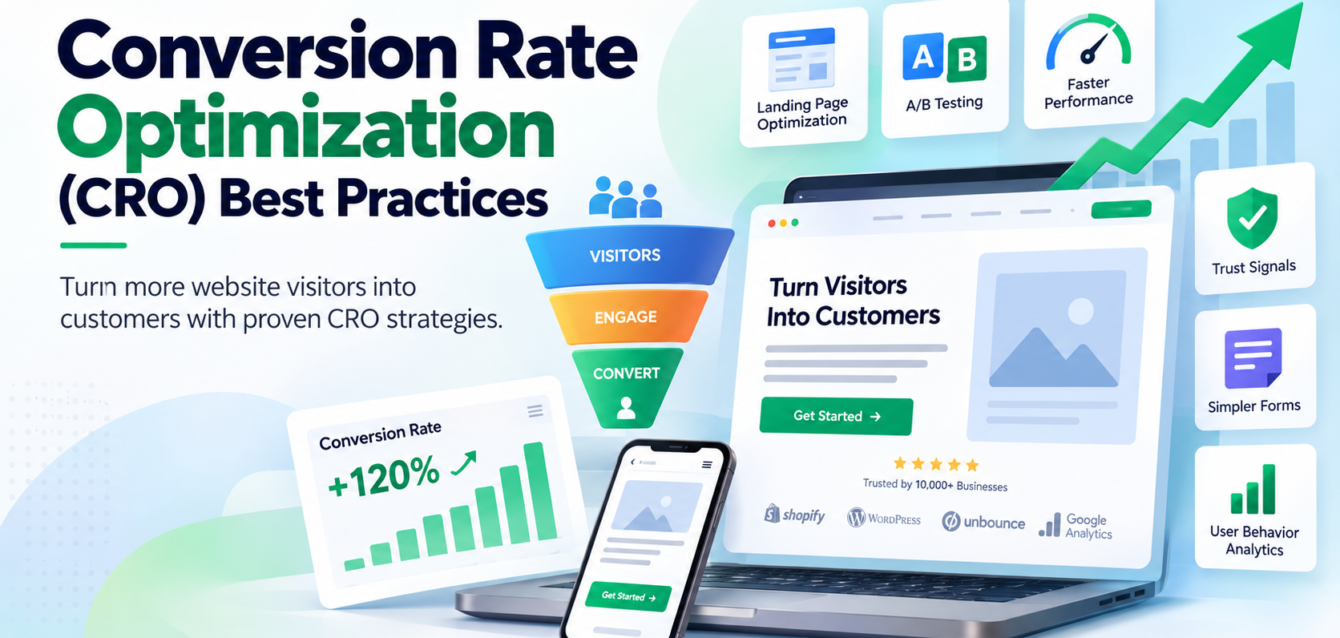
Learning how to increase your conversion rate begins with understanding why visitors are not taking action. While more traffic can certainly help, if your website creates confusion or friction, additional visitors may just lead to more missed opportunities.
Conversion rate optimization (CRO) focuses on making your existing traffic more valuable. This involves improving messaging, simplifying the conversion funnel, enhancing trust, and testing changes based on actual user behavior.
Before redesigning your website, run a free CRO audit to identify potential issues with headlines, calls to action, forms, mobile usability, page speed, and social proof.
In our analysis of over 200 landing pages, we discovered recurring issues such as unclear value propositions, weak message match, hidden calls to action, unnecessary form friction, and limited trust signals—all of which can hinder conversions. For instance, improving a conversion rate from 3% to 4% generates approximately 33% more conversions from the same amount of traffic.
How Can You Increase Conversion Rate Without More Traffic?
You can increase your conversion rate by making it easier for qualified visitors to understand your offer, trust your business, and take the next step. Effective CRO focuses on removing barriers rather than merely attracting more visitors. The conversion rate is calculated as follows:
Conversions ÷ Visitors × 100 = Conversion Rate
For example, if 200 people convert from 10,000 visitors, your conversion rate is 2%. If you increase conversions to 300 while retaining the same traffic, the conversion rate rises to 3%.
A solid website conversion optimization strategy should assess the entire customer journey, including landing pages, forms, product pages, checkout flows, and lead-generation experiences.
Our Dreamer Designs 8-Point CRO Audit Framework evaluates headline clarity, above-the-fold structure, CTA visibility, page speed, mobile optimization, trust signals, form friction, and user behavior.
Improve Your Above-the-Fold Messaging
Effective above-the-fold messaging helps visitors immediately grasp your offer and its significance. Your headline, supporting copy, and call to action should address the visitor’s most pressing questions within seconds. Instead of vague headlines like “Solutions for Modern Businesses,” communicate a specific benefit or outcome.
Message match is especially crucial when visitors arrive from Google Ads, social campaigns, or emails. If your ad promises a free conversion audit, the landing page must reinforce that offer. Headline testing can compare different focuses—benefit-oriented, problem-oriented, or outcome-oriented.
For campaign-specific traffic, a professional landing page can enhance landing page optimization by eliminating unrelated navigation and centering attention on a single conversion goal.
Reduce Conversion Funnel and Form Friction
Conversion funnel optimization aims to eliminate unnecessary effort between visitor interest and the desired action. Confusing navigation, long forms, excessive steps, and unclear instructions can all lower conversions. Form friction is a common issue.
When someone requests an introductory consultation, do you really need their address, annual revenue, budget, phone number, job title, and several written responses right away? Ask only for the information that facilitates the next stage of the relationship.
For ecommerce businesses, conversion optimization should also scrutinize product information, shipping costs, return policies, payment options, and checkout complexity. A Shopify shopper shouldn’t have to search multiple pages just to understand shipping or returns.
As a quick win, complete your own website conversion journey on a mobile device and eliminate one unnecessary field, click, or decision.
Strengthen Calls to Action and Trust Signals
Effective calls to action clearly convey what will happen next, while trust signals alleviate uncertainty about taking that action. Both are crucial for successful website CRO.
Consider these two buttons:
“Submit”
“Get My Free CRO Audit”
The second CTA communicates the value of clicking.
Trust signals can include customer testimonials, recognizable client logos, ratings, reviews, guarantees, case study results, certifications, and security information. Social proof should appear near critical decision points such as forms, pricing, and CTAs.
According to CXL, effective CRO relies on research and experimentation, rather than applying generic best practices. This means your trust signals should specifically address the concerns of your visitors.
Improve Page Speed and Mobile Optimization
Fast, mobile-friendly pages make it easier for visitors to proceed through the conversion funnel. Slow loading times, unstable layouts, confusing forms, and poorly positioned buttons can create friction before users have the chance to evaluate your offer.
Use Google PageSpeed Insights to review core web vitals and identify potential performance problems, paying special attention to oversized images, unnecessary scripts, layout shifts, CTA visibility, button sizes, form spacing, and text readability. Mobile optimization requires more than simply shrinking your desktop design.
Ensure that pages on WordPress, Shopify, and Unbounce are tested on actual mobile devices to guarantee that the most vital content and calls to action remain easily accessible. Improving page speed can also lower bounce rates, but remember that bounce rates alone don’t explain why visitors leave. Combine technical data with behavioral research.
Use Heatmaps and Session Recordings to Find Problems
Behavioral data can reveal where visitors struggle before they abandon your website. Heatmaps illustrate clicks and scrolling patterns, while session recordings provide deeper insights into individual user behavior.
Microsoft Clarity can help you spot missed CTAs, repeated clicks, form hesitation, and sections that visitors seldom reach. For instance, if users consistently abandon one field, investigate that field before overhauling the entire form. If your strongest social proof appears below the point where many visitors stop scrolling, consider moving it higher.
These insights can make landing page CRO efforts more evidence-based. A full CRO dashboard can connect these observations with conversion performance throughout the broader funnel.
Validate Improvements With A/B Testing
A/B testing determines whether a specific change leads to better results than the current experience. This method allows businesses to compare performance rather than rely on personal preferences.
Promising A/B testing opportunities include:
Headlines
CTA wording
Form length
Hero images
Offer positioning
Social proof
Pricing presentation
Page hierarchy
Each experiment should begin with a hypothesis. For example, “Reducing the form from six fields to four will increase submissions because visitors will perceive the process as easier.” Split testing is effective for meaningful variations, while multivariate testing can evaluate combinations of elements but usually requires more traffic. Use Google Analytics 4 to monitor what happens beyond the initial conversion.
Focus on Better Conversions, Not Just More Conversions
Increasing conversion volume is beneficial only when those conversions align with business goals. Lead generation optimization should consider both quality and quantity. A shorter form may yield more leads, but those leads could be less qualified. Similarly, an aggressive exit-intent popup might boost email signups without enhancing customer numbers.
Track metrics such as qualified opportunities, purchases, revenue per visitor, and customer acquisition alongside basic conversion data. While conversion rate benchmarks can provide context, your historical performance and business economics often yield more meaningful targets.
Turn More Website Visitors Into Customers
Understanding how to increase conversion rates requires shifting your focus from merely attracting traffic to enhancing each visitor’s experience. Strengthen your messaging clarity and improve message match. Reduce form friction, fortify your calls to action and social proof, and rectify mobile usability and page speed. Then, utilize heatmaps, session recordings, headline testing, and A/B testing to validate meaningful enhancements.
CRO is not a one-time task; it is an ongoing process that involves understanding user behavior, identifying friction points, testing solutions, and measuring business outcomes. Before determining what to change next, run a free audit to pinpoint the conversion opportunities with the greatest potential impact.
#ConversionRateOptimization #WebsiteCRO #ImproveWebsiteConversions #LandingPageOptimization #ConversionFunnelOptimization #EcommerceConversionOptimization #CROAudit #CROTools