
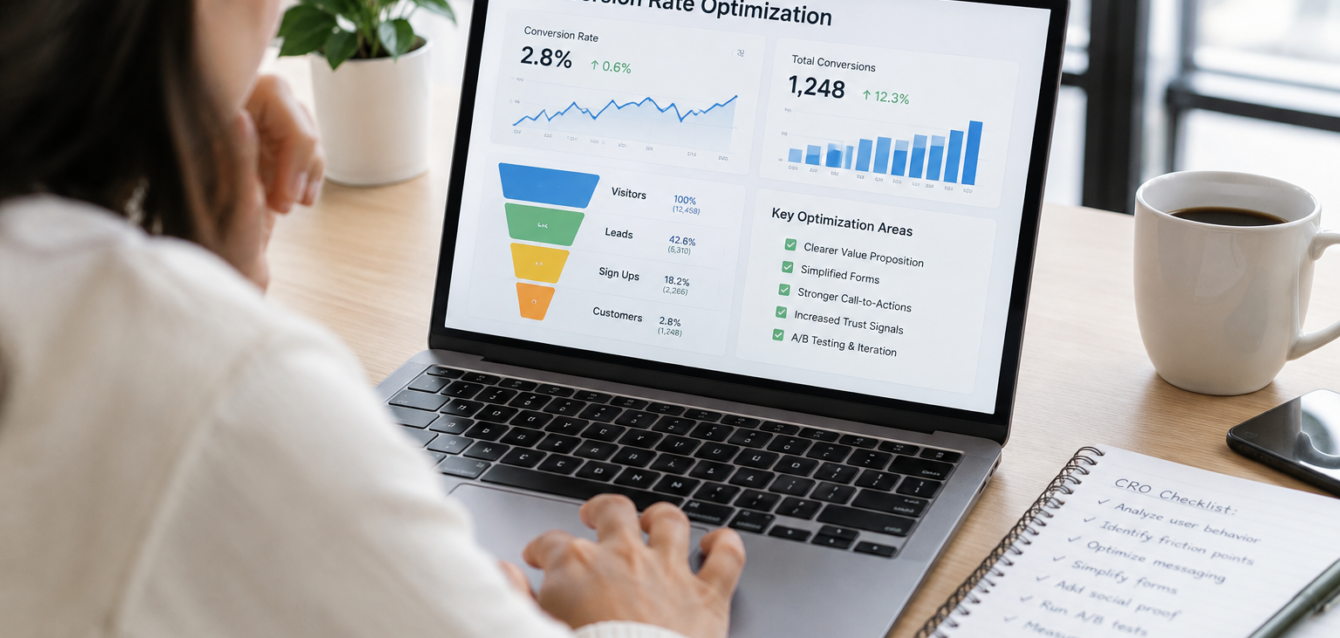
A landing page can look beautiful and still fail to generate leads. This is why businesses increasingly need more than just attractive design; they require landing pages built around conversion goals. An Unbounce designer focuses on creating landing pages that combine strong visuals, clear messaging, intuitive user experience, and a conversion-focused structure. Instead of solely designing for aesthetics, an experienced Unbounce designer considers how every section, headline, form, and call-to-action (CTA) can help guide visitors toward a specific action.
Whether a business is running Google Ads, social media campaigns, email promotions, product launches, or lead generation initiatives, Unbounce landing pages can provide dedicated experiences for each audience. The role of an Unbounce designer is to ensure these experiences are clear, relevant, visually professional, and easy to use.
An Unbounce designer specializes in designing and building landing pages within the Unbounce platform. This work goes beyond merely selecting a template and replacing text. A professional designer takes into account user intent, campaign messaging, visual hierarchy, mobile responsiveness, conversion paths, forms, calls-to-action, and trust signals.
Using the Unbounce Landing Page Builder, a designer can create custom landing pages tailored for specific marketing campaigns. For instance, a page promoting a free consultation may require a different structure than one designed for an eBook download or SaaS product demo.
The designer’s job is to understand the campaign’s goal and transform that objective into a focused landing experience.
Before designing anything, an Unbounce designer must ascertain what the page needs to achieve. Is the goal to generate leads? Book consultations? Encourage free-trial registrations? Sell a product? Capture webinar sign-ups?
A strong Unbounce landing page design should revolve around a primary objective. If a page attempts to promote multiple unrelated actions, visitors may become confused about what to do next. Once the conversion goal is clear, the page can be structured accordingly. Headlines should introduce the value, supporting sections explain the benefits, social proof builds confidence, and the CTA directs visitors towards the desired action.
Visitors typically decide quickly whether a page is relevant to them. Therefore, the top section of the landing page deserves careful attention. An Unbounce designer will emphasize a strong headline, supporting copy, relevant imagery, and a clear call-to-action. The headline must communicate value immediately; generic messaging like “Take Your Business to the Next Level” may look polished but often conveys little.
More specific headlines, such as “Generate More Qualified Leads From Your Existing Website Traffic,” give visitors a clearer reason to continue reading. For high-converting landing pages, the first section should quickly answer three questions: What is being offered? Why does it matter? What should the visitor do next?
Calls-to-action are among the most important elements on any landing page. Generic buttons like “Submit” or “Click Here” provide little context. A conversion-focused Unbounce designer typically recommends more specific CTA language, such as “Get My Free Audit,” “Book My Consultation,” “Start My Free Trial,” or “Request a Demo.” Effective Unbounce conversion optimization also considers the placement of these CTAs.
A CTA might be positioned in the hero section, repeated after critical benefits, and included near the bottom of a longer page. The wording and design should remain consistent, so visitors always understand the main action. The CTA should visually stand out while remaining cohesive with the overall design.
Many businesses utilize Unbounce specifically for lead generation landing pages, which are designed to collect visitor information through forms. However, forms can quickly become a source of friction if they request excessive information. An Unbounce designer should carefully evaluate the value of the offer before determining how many fields to include.
Using effective visual hierarchy can significantly enhance landing page design. Visitors should immediately recognize the headline, primary benefits, CTA, and essential trust signals. An experienced Unbounce designer employs typography, spacing, section hierarchy, imagery, and contrast to guide users naturally through the content.
The design should also communicate credibility. An Unbounce landing page might feature client logos, testimonials, case study results, awards, certifications, ratings, or measurable outcomes. For example, a testimonial near a lead form can reassure visitors right before they submit their details. Social proof is vital, especially when visitors arrive from paid ads and are discovering the company for the first time.
A landing page cannot be deemed complete simply because it appears well-designed on a desktop. A considerable amount of campaign traffic may come from mobile devices, so Unbounce mobile landing pages require the same attention as desktop layouts. Buttons should be easy to click, text should remain readable, forms should be straightforward to complete, and images should scale properly.
The Unbounce Smart Builder can help marketers and designers create structured landing pages tailored to campaign needs. However, tools do not replace thoughtful design. A strong page still requires a clear offer, relevant messaging, logical structure, good typography, effective CTA placement, and a consistent visual system.
One of Unbounce’s significant advantages is its ability to test various versions of a landing page. With Unbounce A/B Testing, designers and marketers can compare different elements like headlines, CTA wording, hero layouts, and images to determine what influences conversions most effectively.
A landing page should reflect the brand but should never complicate the conversion journey. An Unbounce designer must harmonize brand elements with usability. Design decisions must support the page’s goal, ensuring that visitors have fewer reasons to hesitate.
Once the page is published, the designer’s work isn’t over. Landing pages should be analyzed after receiving traffic to evaluate conversion rates, form completion, CTA clicks, lead quality, and overall campaign performance. Continuous Unbounce landing page optimization transforms insights into improved future versions.
In summary, an Unbounce designer is not merely someone who creates attractive landing pages. Their role involves integrating strategy, design, user experience, and conversion thinking into a cohesive page. A strong designer understands how to utilize the Unbounce platform effectively to create successful lead generation landing pages and optimize for conversion.
The best landing pages simplify the visitor’s journey, foster trust, and facilitate next steps. When thoughtful design is coupled with rigorous testing and optimization, Unbounce pages can emerge as powerful marketing assets, helping businesses convert more of their existing traffic.
#UnbounceDesigner #UnbounceLandingPageBuilder #UnbounceSmartBuilder #UnbounceLandingPages #UnbounceLandingPageDesign #UnbounceConversionOptimization #UnbounceLandingPageOptimization #UnbounceA/BTesting #UnbounceLeadGeneration #LandingPageDesignServices #UnbounceMobileLandingPages #LandingPageOptimization