UGC Ads vs AI Video Ads: Why Trust Still Wins (and How AI Makes It Scalable in 2027)
SEO brief (remove before publishing)
• Primary keyword: UGC ads
• Secondary keywords: UGC video ads, AI UGC ads, AI video ads, UGC creator ads, TikTok UGC ads, user generated content ads, UGC for ecommerce, ads as a service
• Long-tail targets: AI vs UGC ads, how to scale UGC ads, UGC ads for TikTok and Reels, AI video ad testing
• Meta title (under 60 characters): UGC Ads in 2027: Why Trust Wins and AI Scales It
• Meta description (under 155 characters): UGC ads still win on trust, while AI wins on speed. See how to combine AI video ads with UGC creators to test faster and convert more.
• Suggested URL slug: /ugc-ads-vs-ai-video-ads
• Note: I can’t access Ahrefs or Semrush from here, so the keywords above come from search intent and common phrasing in this niche. Check volume and difficulty for each in Ahrefs Keywords Explorer or Semrush Keyword Magic Tool, and swap in the best-performing variants.
Think about your own scrolling habits. A glossy brand video comes up on TikTok or Instagram, and your thumb swipes past before the first second ends. Then a real person appears, speaks into their phone, and explains how a product fit into their day. You stop and listen.
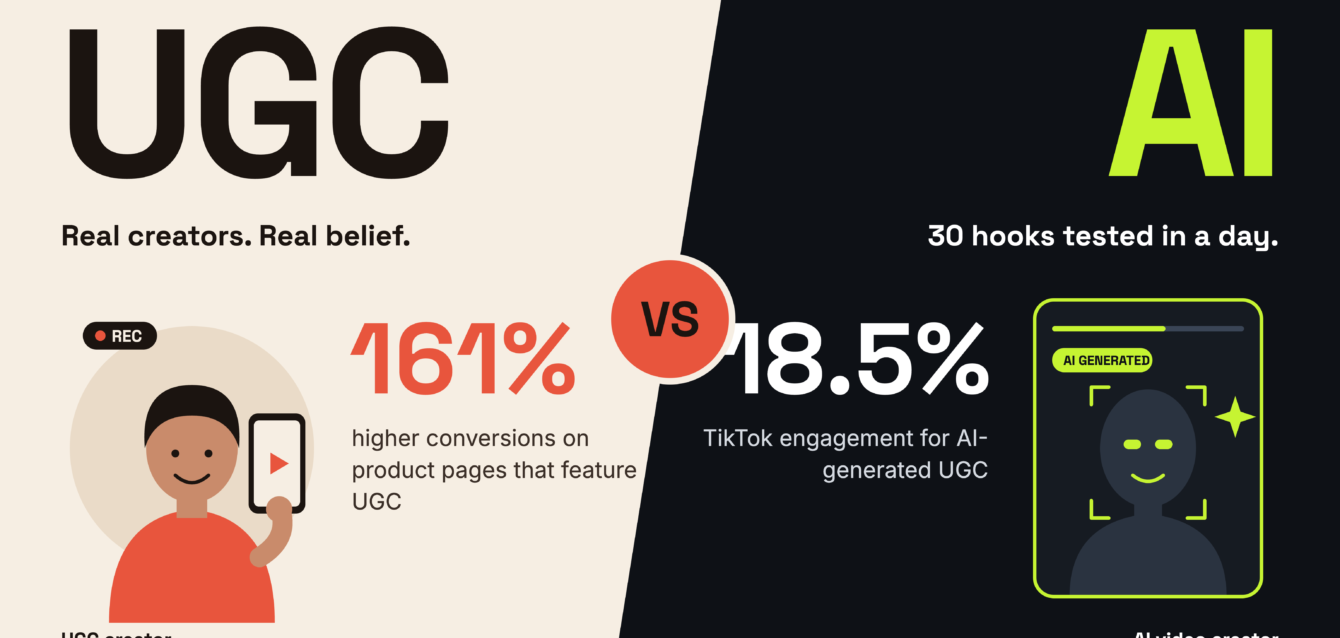
That gap is why UGC ads remain one of the most dependable formats in paid social. Industry data cited by Safcodes shows UGC on product pages can lift conversions by 161%, while AI-generated UGC has posted engagement rates as high as 18.5% on TikTok, compared with 5.3% for human-made UGC.
Put those numbers side by side and the split is obvious. AI gives you speed, volume and engagement. Human creators give you credibility and purchases. Brands that rely only on polished, high-budget creative tend to get ignored, while creator-style videos earn belief because they feel real.
You don’t have to pick one. The strongest paid media teams use AI to find what works and creators to make it convincing. ShortVids packages both into a single subscription.
This guide builds on our earlier breakdown of AI video ads. Here we look at how brands turn AI testing insights into UGC video ads that convert.
What Are UGC Ads, and Why Do They Still Work in 2027?
UGC ads (user-generated content ads) are short videos that look like ordinary posts from real people. Think honest product reviews, quick demos, unboxings, or “day in my life” clips, instead of studio-lit commercials.
They work because they match how people already use TikTok, Instagram Reels and YouTube Shorts. When an ad looks native to the feed, viewers watch longer and platform algorithms reward it with more reach.
Reported benchmarks back this up:
• UGC ads can earn around 4x the click-through rate of traditional brand ads (source: Archive).
• They can cut cost per click by roughly half on average.
• Product pages featuring UGC have seen conversion lifts of 161%, and Yahoo Finance reported UGC driving 6.73x higher conversions than non-UGC content in Q1 2026.
Tip: before publishing, confirm each statistic against its original source and update the year if newer data exists.
The Trust Advantage Many Brands Overlook
People believe what feels like lived experience. When a creator shows a skincare product, applies it on camera and shares real results, the viewer thinks, “She’s like me. If it worked for her, it might work for me.”
This is trust transfer. The creator has already earned credibility with their audience, and when they recommend your product naturally, some of that credibility passes to your brand. Even micro-creators with modest followings lower a viewer’s guard through relatable settings and natural delivery.
The Algorithm Bonus
Native-style TikTok UGC ads and Reels placements often bring:
• Higher video completion rates
• Lower cost per view
• Stronger conversion signals for the ad platform to learn from
Platform fit, human trust and proven results together explain why scalable UGC for ecommerce still outperforms most other creative formats.
Why Creator Trust Beats Polished Production in Paid Social
AI has fixed the production bottleneck. A brand can now generate 30 ad variations in a day and learn what resonates before committing serious spend.
What AI can’t generate is an audience relationship that already exists.
Picture two skincare ads running side by side in Instagram:
• Ad 1, brand-made: clean visuals, professional script, strong call to action.
• Ad 2, creator-led: a casual 45-second phone video from someone the viewer already follows, shot in natural light, with an honest recommendation.
Which one gets saved, shared and bought? Usually the second.
The difference isn’t camera quality. It’s pre-existing trust. Creators carry relationships built over months or years, and a brand that partners with them effectively borrows that relationship for a campaign.
Why this matters:
• Audiences scroll past random brand promotions but stop for creators they know.
• The same message feels different coming from a familiar face.
• Creator content reads as a recommendation, not an advertisement.
• Lower skepticism shortens the path to purchase.
AI wins on cost per click and volume. Creator-led content wins where trust decides the sale, which is where most buying decisions are made.
What AI Video Ads Are Best At
Think of AI video ads as the testing and discovery layer of your creative strategy. They let you explore ideas fast and cheaply before investing in creators.
Instead of spending weeks on a handful of polished spots, you can produce dozens of variations and see which ones connect. Once a hook proves itself, you promote it into creator-led UGC.
AI helps brands:
• Test multiple hooks and message angles quickly
• Lower early-stage production costs
• Spot winning concepts sooner
• Refresh creative before ad fatigue sets in
This is especially useful when you don’t yet know your best angle. AI lets you experiment widely without paying for shoots that may never perform.
AI function
Why brands use it
Hook testing
Find scroll-stopping angles fast
Creative variations
Produce many concepts at scale
Fast iteration
Launch and adjust quickly
Cost control
Cut upfront production spend
Performance discovery
See what audiences respond to most
How AI and UGC Work Together: A Four-Phase System
Many brands still treat AI ads and UGC ads as rivals competing for the same budget. The ones scaling profitably treat them as a connected system where each has a defined job.
Phase
Main system
Strategic purpose
Discovery
AI video ads
Quick hook tests, cheap validation, concept exploration
Learning
AI plus early UGC
Learn what audiences connect with emotionally
Scaling
UGC creator ads
Build trust and lift conversions
Ongoing
AI plus UGC together
Keep volume, freshness and long-term performance
Phase 1: Discovery
Use AI to produce many concepts with different hooks, emotional angles and calls to action. Small budgets generate quick data. The goal isn’t a polished campaign. It’s finding which message your audience responds to before you spend heavily.
Phase 2: Learning
Once patterns emerge (this hook holds attention, that angle earns longer watch time, this CTA drives clicks), start layering in early UGC. Formats like face swap video can also be tested here to explore variations. Creators then build content around the two or three strongest angles, combining tested messaging with human delivery.
Phase 3: Scaling
Now scale creator-led UGC around the validated hook, the proven message and the audience segment that responded best. Conversions compound because a trusted voice is delivering a message the data has already approved.
The Creator Hiring Problem
Most brands that build UGC programs on their own hit the same wall. Finding creators takes weeks. Then come outreach, negotiation, contracts, briefs and revisions, and the content often arrives late or off brief. Marketplaces add placement fees, rates vary widely, and consistency across campaigns is hard to keep.
For brands spending real money on paid social, a three-week sourcing cycle every time creative needs refreshing isn’t sustainable.
ShortVids removes that friction with a ready talent pool spanning ethnicities, age groups, niches, content styles and demographics. You skip outreach and negotiation and get matched with a creator who fits your product and audience.
How ShortVids Turns AI Testing into UGC Campaigns
ShortVids uses AI-powered production for discovery and testing, then its creator network for trust and scale, all under one subscription. There are no separate agencies, disconnected workflows or briefing gaps between what the data found and what the creator says on camera.
This is the idea behind ads as a service (AaaS): an ongoing paid creative system that covers strategy, AI testing, UGC production, revisions and delivery each month for one flat rate, with no per-video editing fees and no agency markup on creator sourcing.
The ShortVids AI-to-UGC Process
Step 1: AI testing. ShortVids produces multiple hooks, concept angles and format tests using AI-supported workflows, including UGC-style and polished versions in platform-ready files. Delivery is under 48 hours.
Step 2: Pick the winners. Performance data shows the strongest hooks, concepts and emotional angles. These become the foundation of the UGC brief, so creators never have to guess what to say.
Step 3: Creator matching and production. Creators are matched by target demographic, product category and content style, then produce platform-native content around the validated hooks.
Proof in practice: ShortVids client Gene Slade grew from 50 to 150+ creatives a month without adding internal headcount. AI handled volume, while the ShortVids team handled strategy, creator matching and quality control.
AaaS Plans and Pricing
Plan
Price
Best for
Startup Plan
From $999/month
Early-stage brands that want to test AI plus UGC without a big commitment
Growth Plan
$2,499/month
Brands scaling creative volume with unlimited AI-generated ads and UGC variations
Production Plan
$5,000/month
End-to-end production, including scripting, filming, talent sourcing and high-volume output
Growth and Production plans include unlimited creatives, continuous testing support, unlimited revisions, and delivery for Meta, TikTok, Reels and YouTube Shorts, with no long-term contracts and no per-video billing. The Startup Plan is customized to your stage and goals.
About The Dreamer Designs: The Studio Behind This Strategy
The Dreamer Designs is a New Delhi-based design, web development and video studio led by founder Nishant Sapra. The team helps brands turn ideas into creative that converts, and it is listed with verified client reviews on Clutch, GoodFirms and DesignRush.
What We Do
• Graphic design and brand identity, including logos, presentations and brand books
• WordPress, Elementor and Shopify website design and development
• Digital ad creative for Meta and Google
• Social media graphics and short-form video
You can browse recent work on our Dribbble portfolio.
How We Are Scaling the Business
We are growing by turning one-off design jobs into a repeatable creative system, the same AI-plus-UGC approach this article describes.
• One team, one workflow. Design, web and ad creative sit under one roof, so the ad, the landing page and the brand all say the same thing.
• AI for speed, creators for trust. We test hooks and formats quickly with AI, then move the winners into creator-led, UGC-style content.
• Systems over single projects. Ongoing monthly creative support replaces scattered per-project work, which keeps quality steady as volume grows.
• Proof in public. Client reviews, directory listings and a live portfolio let new brands check our work before they get in touch.
Editor’s note: add your real growth numbers here (team size, clients served, creatives delivered per month) to make this section stronger.
Key Takeaway
The best-performing brands in 2027 don’t choose between AI and UGC. They run both in one system. AI brings speed, testing and discovery, and UGC brings trust and connection. ShortVids runs the whole workflow under a single subscription.
Stop guessing and start scaling with speed and credibility together. Book a call with ShortVids and get your AI plus UGC system running in days.
Ready to Scale? Work With The Dreamer Designs
If you want sharper creative, faster testing and a website that converts the traffic your ads bring in, we would like to hear about your project.
• Website: thedreamerdesigns.com
• Services: graphic design, branding, web design and development, ad creative, video
• Next step: visit thedreamerdesigns.com, share your goals, and get a tailored plan for your brand.
Frequently Asked Questions
How do AI ads and UGC ads work together?
AI runs fast, low-cost tests across 20 to 30 hook variations to find the messages that resonate. Creators then deliver those winning angles on camera with the authenticity that drives purchases. AI handles discovery, and creators handle conversion.
Can AI-generated ads replace UGC creators?
Not fully. AI cuts testing costs and boosts volume, but it can’t replicate the trust a real creator has built with an audience. People react differently to a familiar face than to an AI avatar, and for most product categories creator-led UGC outperforms pure AI creative at the conversion stage.
How much do UGC ads cost compared with AI video ads?
Hiring creators through marketplaces can cost thousands of dollars per collaboration, plus time for sourcing, negotiation and revisions. ShortVids Ads as a Service starts at $2,499 per month for the Growth Plan and covers both AI creatives and UGC production at a flat rate, with a Startup Plan from $999 per month.
Which platforms are best for UGC ads?
TikTok, Instagram Reels, Meta feed placements and YouTube Shorts deliver the strongest results, because each rewards content that feels native. ShortVids provides platform-formatted files for all four, ready to launch.
How does ShortVids find UGC creators?
ShortVids keeps a vetted in-house creator network, so there’s no marketplace browsing, outreach or rate negotiation. You share your target demographic, product category, content style and audience type, and ShortVids matches a creator and manages production from brief to delivery.
Why do brands still use UGC ads?
Because trust remains a leading driver of purchase decisions. A frequently cited figure says 79% of consumers believe UGC significantly influences what they buy. Even as AI creative improves, authentic creator content tends to win on conversion rate and purchase intent, especially for DTC, ecommerce and beauty brands where personal recommendations carry weight.
Trusted Resources and Further Reading
Platform Guides for Paid Social
• Meta for Business: ad formats, best practices and creative guidance for Facebook and Instagram
• TikTok for Business: creative tools and advertising resources for TikTok campaigns
• Think with Google: consumer insight and video marketing research from Google
Agency Profiles and Reviews
• The Dreamer Designs on Clutch
• The Dreamer Designs on DesignRush
• The Dreamer Designs on GoodFirms
• The Dreamer Designs on The Manifest
• The Dreamer Designs on Dribbble