Conversion Rate Optimization (CRO) is essential for businesses aiming to convert website visitors into paying customers. While driving traffic to your website is crucial, the real challenge lies in encouraging those visitors to take meaningful actions. By following effective CRO best practices, businesses can enhance user experience, reduce bounce rates, increase sales, and generate more qualified leads—all without spending extra on advertising. Regardless of whether you operate an ecommerce store, a SaaS platform, or a lead generation website, optimizing your conversion funnel can significantly enhance your marketing performance. Begin by identifying improvement opportunities with a free CRO audit.
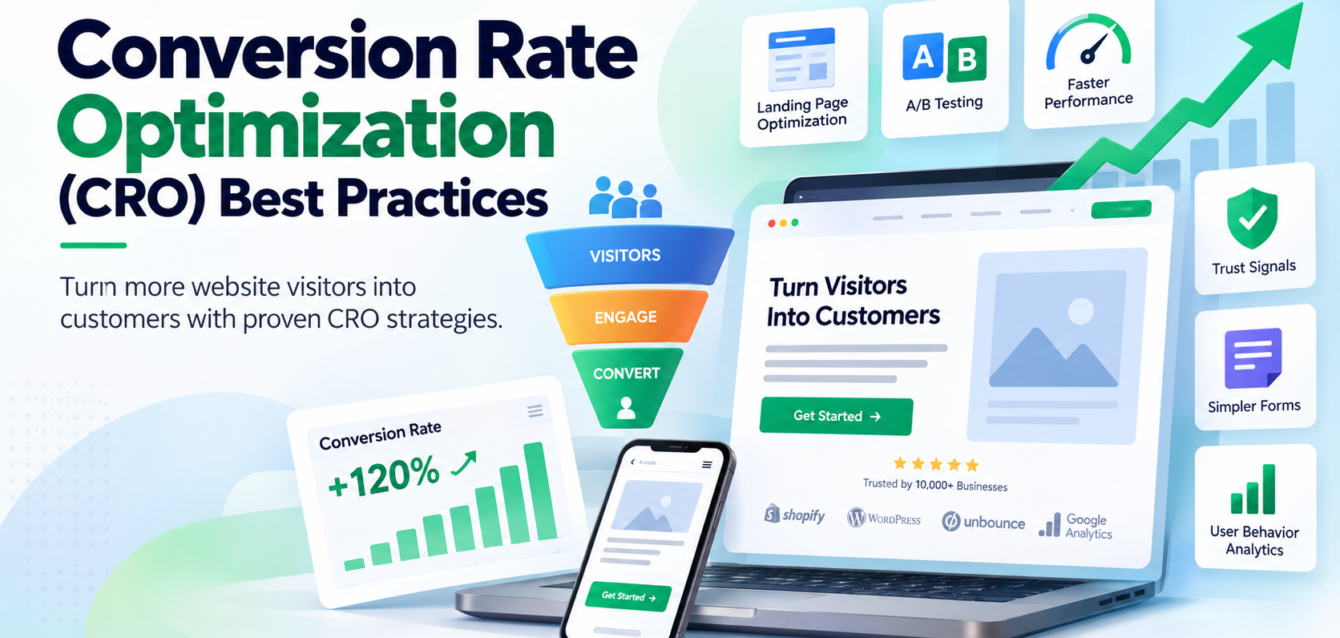
CRO best practices consist of proven strategies designed to enhance the percentage of website visitors who complete a desired action, such as making a purchase, submitting a form, or booking a consultation. These strategies involve user behavior analysis, landing page optimization, A/B testing, and data-driven design improvements. Unlike search engine optimization, which focuses on attracting traffic, CRO emphasizes making existing traffic more valuable. A successful strategy begins with understanding visitor expectations, pinpointing friction points, and implementing targeted improvements to encourage conversions.
An effective landing page immediately communicates its value and guides visitors toward a clear action. The headline should convey the primary benefit, while supporting content addresses customer needs and concerns. Ensure that critical information is placed above the fold, including a compelling call to action (CTA). Maintaining message match between advertisements and landing pages instills confidence in visitors that they have reached the right destination. Avoid unnecessary distractions, complicated navigation, and excessive text. Businesses seeking improved results can invest in a professional landing page with a focus on usability, clarity, and conversion-driven design.
Website performance directly impacts user engagement and conversion potential. Slow-loading pages can frustrate users, leading to abandoned transactions and discouraging them from completing purchases or submitting forms. Enhancing page speed through image compression, efficient coding, and minimizing unnecessary scripts can deliver a smoother experience. Mobile optimization is equally crucial, as many visitors browse and transact using smartphones. Implement responsive layouts, readable content, accessible navigation, and touch-friendly buttons for easier interaction. Utilize Google PageSpeed Insights to uncover performance issues and evaluate core web vitals, helping prioritize improvements that benefit actual users.
A/B testing enables businesses to compare different webpage versions to identify which performs better. Instead of making assumptions, marketers can test headlines, CTA buttons, product images, pricing presentations, and form layouts. Testing one major change at a time simplifies the interpretation of results. For more complex scenarios, multivariate testing can assess various elements when there is enough traffic for reliable analysis. Each experiment should include a clear hypothesis, defined success metrics, and sufficient sample size. Regular split testing allows businesses to enhance click-through rates and conversion performance while avoiding costly redesigns based on personal preferences.
Trust is a key factor in purchasing decisions, especially for visitors unfamiliar with a business. Customer testimonials, authentic reviews, case studies, recognizable client logos, and transparent policies can reassure potential customers that the company delivers on its promises. Position relevant trust signals near pricing information, checkout forms, and CTA buttons to reduce hesitation at critical points. Social proof should be specific, credible, and connected to customer concerns—testimonials detailing measurable business improvements tend to be more persuasive than generic praise. Avoid fabricated reviews or exaggerated claims, as credibility fosters long-term customer relationships.
Complicated forms and confusing checkout experiences create unnecessary barriers between visitors and conversions. To reduce friction, only request the essential information needed to complete the immediate action. Shorter forms, clear field labels, helpful error messages, and straightforward checkout steps enhance the overall experience. Ecommerce businesses utilizing platforms like Shopify or WordPress should also review payment options, shipping information, and account creation requirements. For lead generation websites, minimizing unnecessary fields can encourage more inquiries. A well-designed CRO platform can assist teams in organizing optimization efforts and pinpointing areas that need attention.
Understanding visitor behavior on your website is critical for effective optimization. Tools such as Microsoft Clarity offer heatmaps and session recordings that illuminate click, scroll, and navigation patterns. A heatmap can reveal overlooked CTA buttons, while session recordings may highlight confusing interactions or unexpected form difficulties. Google Analytics 4 helps measure engagement and critical user actions throughout the conversion funnel. Combining quantitative performance metrics with behavioral insights strengthens the decision-making foundation. Regular reviews can uncover opportunities related to exit intent, bounce rates, and landing page engagement.
Successful conversion optimization is an ongoing process rather than a series of occasional design changes. The Dreamer Designs 8-Point CRO Audit Framework focuses on headline clarity, above-the-fold content, CTA visibility, page speed, mobile usability, trust signals, form friction, and behavioral analysis. Evaluating these elements collectively allows businesses to identify weaknesses and prioritize changes based on potential impact. Teams should establish conversion rate benchmarks, review performance regularly, and validate improvements through controlled experiments. For landing pages designed with Unbounce, collaborating with an Unbounce specialist can help align page design with campaign goals.
By implementing effective CRO best practices focused on removing friction, building trust, improving usability, and testing meaningful changes, businesses can turn more website visitors into loyal customers. Continuous measurement and refinement of your website experience can enhance conversions without solely relying on increased traffic. Start with a free landing page audit from The Dreamer Designs to uncover practical opportunities for boosting your website’s conversion performance.
#CRObestpractices #Conversionrateoptimization #Landingpageoptimization #Improvewebsiteconversionrate #CROstrategies #A/Btesting #Websiteconversionoptimization #Conversionfunneloptimization #Ecommerceconversionoptimization #CROaudit