
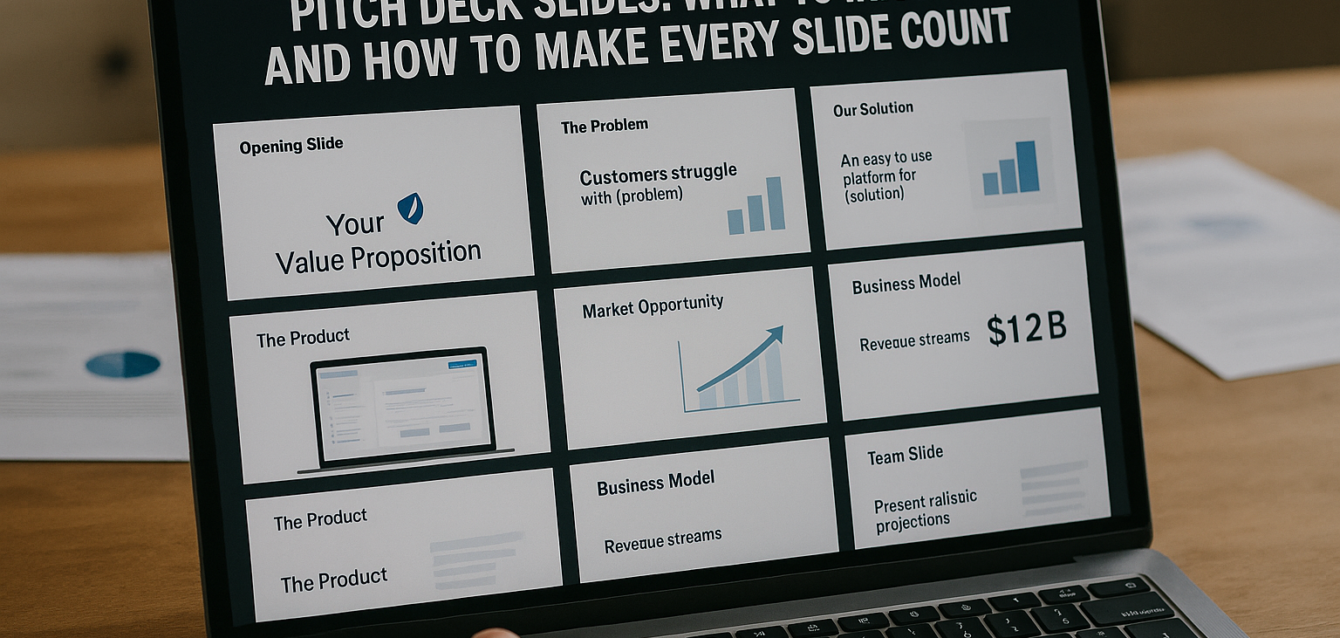
A pitch deck isn’t powerful because it has beautiful slides.
It’s powerful because every slide helps tell a convincing business story.
Whether you’re raising funding, pitching a startup, introducing a new product, or presenting an opportunity to potential partners, your pitch deck slides need to communicate complex information quickly and clearly.
The challenge is deciding what deserves a slide, what should be removed, and how everything should flow together.
Put too much information in your presentation, and you risk overwhelming your audience. Include too little, and important questions remain unanswered.
A strong pitch deck finds the balance.
Let’s look at the most important pitch deck slides and how to make each one work harder for your business.
What Are Pitch Deck Slides?
Pitch deck slides are the individual pages that together form your business presentation.
Each slide should have a specific purpose.
One might introduce the problem. Another explains your solution. Another demonstrates market opportunity or traction.
The important thing is that your slides shouldn’t feel like separate pieces of information.
They should work together.
Think of your pitch deck as a story where every slide answers one question while naturally creating interest in the next.
For many startup presentations, the structure may look something like:
Introduction → Problem → Solution → Product → Market → Business Model → Traction → Competition → Go-to-Market → Team → Financials → Funding Ask
Your exact structure will depend on your company, audience, and stage.
1. The Opening Slide
Your opening slide creates the first impression.
Keep it simple.
You generally need your company name, logo, and a short positioning statement that explains what the business does.
Avoid vague statements like:
“Transforming the Future Through Innovation.”
It sounds impressive but tells the audience almost nothing.
Instead, communicate something specific.
For example:
“AI-powered inventory management for independent retailers.”
Within seconds, the audience understands the category, technology, and customer.
Your opening pitch deck slide doesn’t need to explain everything.
Its job is to make people interested enough to continue.
2. The Problem Slide
Before introducing your product, establish why it needs to exist.
Your problem slide should explain a real challenge experienced by a clearly defined customer.
What is difficult today?
How much time or money does the problem cost?
How frequently does it happen?
Why aren’t current solutions good enough?
Use statistics, customer insights, or simple real-world examples where appropriate.
Don’t exaggerate the problem to make your business appear more important.
Investors and experienced decision-makers will notice.
A believable problem creates a stronger foundation for everything that follows.
3. The Solution Slide
Now introduce your answer to the problem.
This is where many founders try to explain every product feature.
Resist that temptation.
Your solution slide should communicate the fundamental idea.
What does your product do, and how does it make the customer’s situation better?
A screenshot, diagram, product visual, or three-step explanation can often communicate the solution better than a paragraph.
If your audience needs five minutes to understand your solution, simplify the slide.
4. The Product Slide
The solution explains the idea.
The product slide shows how it actually works.
For software companies, this might include screenshots of the interface or a simple user journey.
For a physical product, use strong product photography or diagrams.
For a service business, you could visualize your process.
Don’t cover the slide with ten screenshots.
Choose the one or two visuals that best demonstrate the product’s value and annotate the important elements.
Your goal is to help the audience imagine someone actually using your solution.
5. The Market Opportunity Slide
A great product isn’t automatically a great investment opportunity.
Investors want to understand how large the business could become.
Your market slide might include:
TAM – Total Addressable Market
The overall potential market.
SAM – Serviceable Available Market
The part of that market your business can realistically serve.
SOM – Serviceable Obtainable Market
The share you could reasonably capture based on your current strategy.
The biggest number isn’t always the most convincing.
Your assumptions should be realistic and supported by credible research.
A thoughtful market analysis demonstrates that you understand where your company fits.
6. The Business Model Slide
At some point, your audience is going to ask:
“How does this business make money?”
Your business model slide should answer that immediately.
Explain whether you generate revenue through subscriptions, one-time purchases, commissions, licensing, usage-based pricing, enterprise contracts, or another model.
If appropriate, show your pricing structure.
Keep it straightforward.
You shouldn’t need a complicated diagram to explain how money moves from your customer to your business.
7. The Traction Slide
For many pitch decks, this is one of the most important slides.
Traction demonstrates that your idea is becoming a real business.
Depending on your stage, you might show:
Revenue
Monthly recurring revenue
Customer growth
Active users
Retention
Partnerships
Signed contracts
Pilot programs
Waitlist growth
Choose metrics that demonstrate meaningful progress.
If revenue has grown strongly, visualize the trend rather than presenting a table full of numbers.
If you’re still early, show evidence that customers actually want what you’re building.
Evidence is more persuasive than predictions.
8. The Competition Slide
“We have no competitors” is rarely a convincing statement.
Even if nobody offers exactly the same product, customers are probably solving the problem somehow.
Your competition might include direct competitors, traditional processes, spreadsheets, internal teams, or doing nothing.
The competition slide should demonstrate that you understand the market.
Show where alternatives are strong and where your solution is different.
Avoid creating a comparison table where your company magically has every green checkmark and every competitor has red crosses.
A balanced comparison usually feels more credible.
9. The Go-to-Market Slide
Building a great product doesn’t automatically bring customers.
Your go-to-market slide explains how you plan to reach them.
This might involve:
SEO.
Paid advertising.
Outbound sales.
Partnerships.
Product-led growth.
Marketplaces.
Industry events.
Channel distribution.
Don’t simply write “digital marketing.”
Explain which channels matter, why they’re appropriate for your target customer, and how you expect them to contribute to growth.
This demonstrates that you’ve thought beyond product development.
10. The Team Slide
Ideas matter, but people execute them.
Your team slide should help investors understand why your team is capable of building this company.
Include key founders and important team members.
Focus on relevant experience rather than long biographies.
Previous startup experience, industry expertise, technical capabilities, major achievements, or unique domain knowledge can all be valuable.
The underlying question is:
“Why is this the right team to solve this particular problem?”
Answer that clearly.
11. The Financial Slide
Your financial slide should demonstrate that you understand the economics of your business.
Depending on your stage, you might include revenue projections, expenses, gross margins, recurring revenue, customer acquisition costs, or cash requirements.
Keep projections realistic.
A startup showing enormous future revenue without explaining the assumptions behind it may create more questions than confidence.
Investors don’t expect you to predict the future perfectly.
They want to understand how you think about the business.
12. The Funding Ask Slide
If you’re fundraising, don’t finish without explaining what you’re asking for.
State how much you’re raising and what that capital will enable.
For example:
“Raising $2 million to expand engineering, grow our sales team, and launch in three additional markets.”
Connecting funding to specific milestones makes the ask easier to understand.
Don’t make investors search through the presentation to figure out why you need their money.
How Should Pitch Deck Slides Be Designed?
Good pitch deck design isn’t about decorating every slide.
It’s about making information easier to consume.
Use strong visual hierarchy so viewers immediately know where to look.
Keep typography consistent.
Use whitespace intentionally.
Create simple charts.
Use meaningful imagery.
Keep colors consistent with your brand.
Most importantly, avoid turning slides into documents.
If you’re presenting the deck live, the slides should support what you’re saying—not duplicate your entire speech.
If the deck will be emailed and read independently, you can provide slightly more context, but readability should remain a priority.
One Slide, One Main Idea
A useful rule when creating pitch deck slides is:
One slide = one main message.
Ask yourself:
“If someone remembers only one thing from this slide, what should it be?”
Then build the design around that answer.
Maybe it’s:
Revenue grew 240% this year.
Or:
Businesses lose 15 hours every week because of this problem.
Or:
We can acquire customers profitably.
That message should be visually dominant.
Everything else supports it.
Can AI Help Create Pitch Deck Slides?
Absolutely.
AI can help generate outlines, organize rough content, shorten copy, brainstorm headlines, summarize market research, suggest slide structures, and explore visual concepts.
This can dramatically speed up early-stage presentation creation.
But AI doesn’t automatically know which parts of your business story matter most.
It may generate a polished-looking slide while emphasizing the wrong information.
Use AI as an assistant.
Let it help you explore faster.
Then use human business judgment, storytelling, and design expertise to determine what belongs in the final deck.
Final Thoughts
Great pitch deck slides don’t try to say everything.
They communicate the right things clearly.
Start by understanding your audience.
Build a logical narrative.
Give each slide a specific purpose.
Prioritize evidence over claims.
Simplify complicated information.
Use professional presentation design to create hierarchy rather than decoration.
And remember that every slide should move your story forward.
Because your audience isn’t investing in your presentation.
They’re evaluating the business behind it.
Your pitch deck slides simply need to make that business easier to understand, believe in, and remember.
#PitchDeckSlides #pitchdeckdesign #investorpitchdeck #startuppitchdeck #pitchdeckpresentation #pitchdeckdesigner #investorpresentation #fundraisingpitchdeck #pitchdeckexamples #professionalpitchdeckdesign #investordeckslides #pitchdeckstructure #businesspitchdeck