
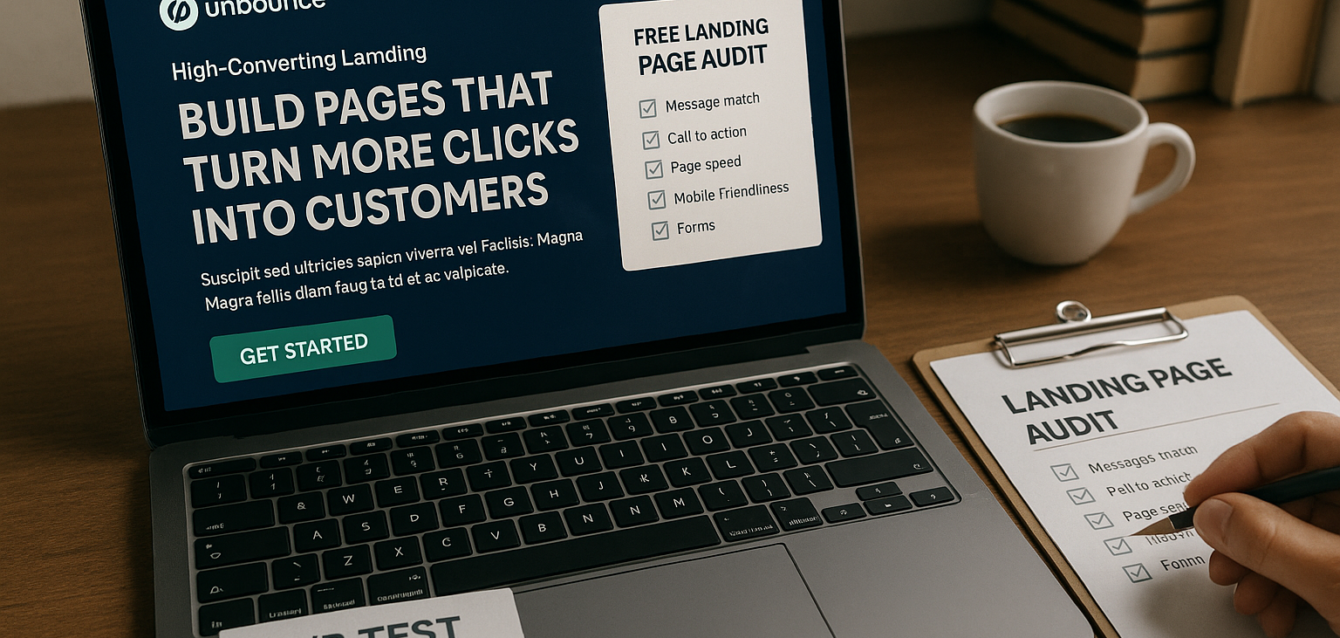
A landing page should do more than look polished. It should turn paid clicks, organic visitors, and campaign traffic into leads, bookings, trials, or sales. Professional Unbounce landing page design services combine strategy, copy, UX, testing, and conversion rate optimization around one measurable goal.
Businesses often spend heavily on Google Ads, Meta Ads, LinkedIn campaigns, and email marketing while sending visitors to pages with weak messaging, unclear calls to action, or unnecessary form friction. Before rebuilding a campaign, a free landing page audit can uncover the biggest conversion barriers.
For teams that need campaign pages quickly, an Unbounce landing page builder makes it easier to create, test, and refine focused landing experiences without redesigning an entire website.
What Are Unbounce Landing Page Design Services?
Unbounce landing page design services combine landing page strategy, visual design, copy structure, development, tracking, and CRO into a page built to drive a specific action. Unlike a general website, which may support many user journeys, a landing page usually focuses on one conversion goal.
Effective design starts with the visitor. What brought them to the page? What did the ad promise? What problem are they trying to solve? What proof do they need before taking action?
In our analysis of 200+ landing pages, we found that unclear message match, competing calls to action, weak social proof, and unnecessary form friction repeatedly created conversion opportunities.
A landing page succeeds when the right visitors understand the offer, trust it, and take the intended action.
Our landing page design service is built around that principle.
Why Use Unbounce for Conversion-Focused Landing Pages?
Unbounce is useful for businesses that need campaign-specific pages without constantly changing their main website. It allows marketing teams to create focused experiences for different audiences, offers, and traffic sources.
For paid advertising, message match is especially valuable. A visitor who clicks an ad for a specific service should land on a page that continues the same promise. A generic homepage can introduce unnecessary distractions.
An Unbounce page builder can also support landing page optimization alongside a WordPress or Shopify website, giving teams greater flexibility to test campaign ideas.
However, Unbounce is only the platform. Conversion strategy determines what should appear on the page, how the offer is positioned, and what should be tested.
The Dreamer Designs 8-Point CRO Audit Framework
Our Dreamer Designs 8-Point CRO Audit Framework focuses on the factors most likely to influence visitor decisions. The goal is to build landing pages around evidence and conversion intent rather than appearance alone.
1. Define One Primary Conversion Goal
Every landing page needs one main outcome. That could be booking a consultation, requesting a quote, starting a trial, downloading a resource, or completing a purchase.
Too many unrelated CTAs can weaken the conversion funnel. Define the primary conversion first, then track supporting metrics such as click-through rate, form completion, lead quality, or revenue per visitor.
Google Analytics 4 can help connect landing page activity with meaningful outcomes.
2. Create Strong Message Match Above the Fold
Visitors should immediately see that the page matches the ad, email, or search result they clicked. Strong message match reduces confusion and keeps the journey consistent.
Above the fold, focus on a clear headline, concise supporting copy, relevant visuals, and one obvious call to action.
With Unbounce landing page optimization, businesses can create dedicated messaging for individual campaigns instead of sending every audience to the same generic page. Headline testing can then compare benefit-led, problem-led, and outcome-led messaging.
3. Design Around the Visitor’s Decision Journey
A high-converting page should answer questions in the order visitors are likely to ask them. Instead of treating each section as an isolated design block, create a persuasive flow from offer to proof to action.
A typical structure includes the core offer, benefits, social proof, objection handling, supporting details, and a final CTA.
For lead generation, visitors may need testimonials and process information before submitting a form. For ecommerce conversion, shoppers may prioritize product benefits, reviews, shipping details, and guarantees.
4. Reduce Form Friction
Forms are a major source of conversion friction. Asking for unnecessary information can make a simple action feel difficult.
Only request information the business truly needs at that stage. A first-touch lead generation form may not need a phone number, company size, budget, and several custom questions.
An Unbounce lead generation landing page can be built around shorter forms, clear labels, better mobile usability, and a stronger value exchange.
5. Place Trust Signals Near Conversion Points
Trust signals help reduce uncertainty and answer the question: “Why should I believe this business?”
Useful social proof can include testimonials, customer logos, reviews, measurable results, guarantees, security messaging, and transparent policies.
Placement matters. A relevant testimonial close to the form or call to action can support the visitor at the moment they are deciding whether to convert.
Different audiences also need different proof. SaaS buyers may value recognizable companies and case study results, while Shopify shoppers may depend more on product ratings and customer reviews.
6. Improve Page Speed and Mobile Optimization
Landing pages need to load quickly and function smoothly on mobile devices. Slow loading, unstable layouts, oversized images, and difficult forms can create friction before visitors even evaluate the offer.
Use Google PageSpeed Insights to review page speed and core web vitals. Check heavy images, third-party scripts, and layout shifts that may affect usability.
Every Unbounce mobile landing page should also be reviewed on real devices. Button sizes, spacing, forms, sticky elements, and long headlines can behave differently on smaller screens.
7. Use A/B Testing Instead of Opinions
A/B testing helps businesses compare page variations based on actual user behavior rather than personal preference.
Start with a clear hypothesis. For example, changing a generic CTA such as “Submit” to “Get My Free Estimate” may increase conversions because it communicates the value of taking action.
Unbounce A/B testing can be used for headlines, CTA copy, hero sections, forms, and other high-impact elements. Split testing can compare significantly different page concepts, while multivariate testing can evaluate combinations when traffic volume supports it.
The goal is not to run endless tests. Each experiment should answer a meaningful conversion question.
8. Combine Analytics With Behavioral Research
Analytics shows what happened. Behavioral research can help explain why.
A heatmap reveals where visitors click and how far they scroll. A session recording can expose confusing interactions, repeated clicks, skipped content, or hesitation around forms.
Microsoft Clarity is useful for studying these behaviors. Pair its findings with your full CRO dashboard rather than relying on one tool alone.
If visitors consistently abandon the same field, reducing form friction may matter more than redesigning the hero. If an important section receives little attention, repositioning or rewriting it may deserve testing.
What Makes Professional Unbounce Landing Page Design Different?
Professional Unbounce landing page design connects every design decision to a conversion objective. Templates can speed up production, but they cannot determine the right message hierarchy, proof, CTA strategy, or testing roadmap for your audience.
An Unbounce landing page template may provide a starting point, but customization is what aligns the page with your traffic source, customer objections, offer, and conversion funnel.
An experienced Unbounce specialist can also build repeatable campaign systems for PPC campaigns, product launches, locations, audiences, and offers rather than creating isolated pages.
Common Problems That Hurt Landing Page Performance
Most underperforming pages lose conversions through several small points of friction rather than one major flaw. The most common problems include too many calls to action, generic headlines, weak mobile optimization, missing social proof, long forms, and launching without a testing plan.
A landing page should have a clear conversion priority. Headlines should communicate a specific benefit instead of using vague copy such as “Solutions for Your Business.” Mobile layouts should be designed for smaller screens rather than simply shrinking the desktop version.
Most importantly, optimization should continue after launch. Use analytics, heatmaps, session recordings, customer insights, and Unbounce conversion optimization to decide what deserves testing next.
Running a CRO analyzer before creating your experiment roadmap can help identify the highest-priority issues.
Build Unbounce Pages Around Conversion, Not Decoration
The best Unbounce landing page design services combine strategy, persuasive messaging, user behavior research, strong UX, and continuous experimentation. Unbounce provides the tools to create and test pages, but the conversion strategy behind those pages determines whether campaigns have a strong foundation for growth.
Use Unbounce landing page software to create focused experiences for different campaigns and audiences, then support those pages with Google Analytics 4, Microsoft Clarity, heatmaps, session recordings, page speed monitoring, headline testing, and disciplined A/B testing.
If you need expert implementation, our Unbounce specialist services can turn campaign strategy into conversion-focused landing pages. Before deciding what to redesign or test, run a free audit to uncover the conversion opportunities already present on your page.
#Unbouncelandingpagedesign #Unbouncelandingpagedesigner #Unbouncelandingpagebuilder #Unbouncelandingpageoptimization #Unbounceconversionoptimization #UnbounceA/Btesting #Unbouncelandingpagetemplates #Unbounceleadgeneration #Unbouncelandingpagedevelopment #Unbouncelandingpageexpert #Unbouncemobilelandingpages