
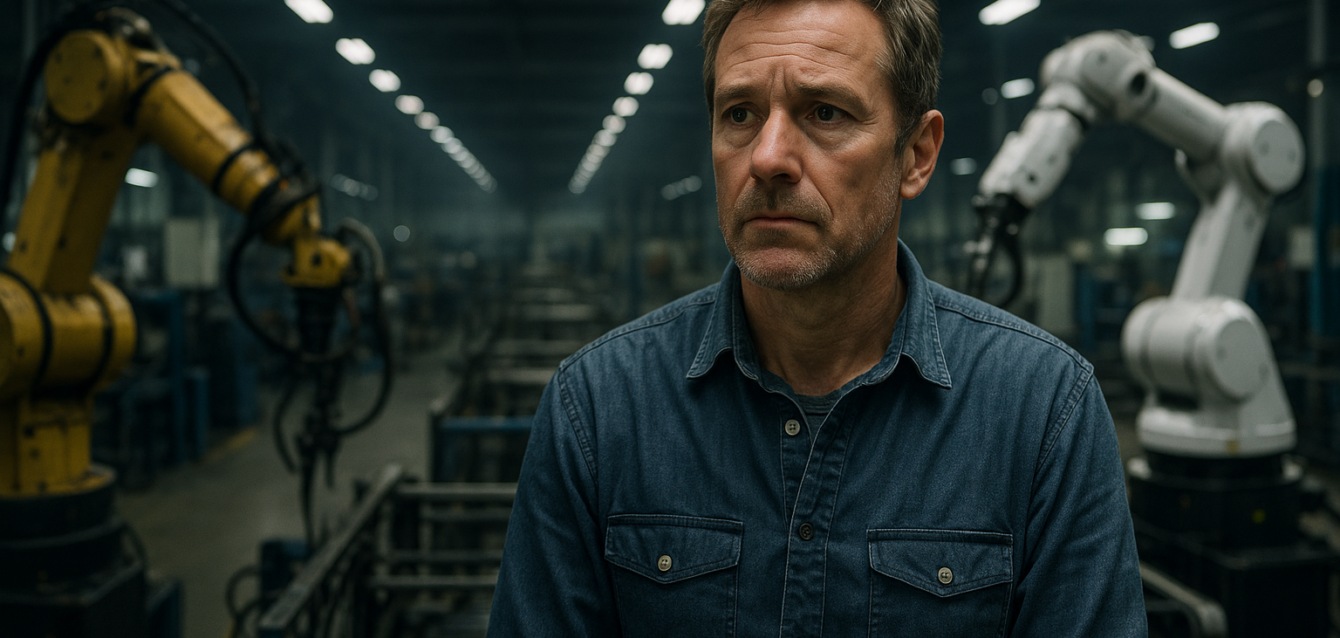
Imagine walking into a factory of the near future. There are no bright lights over production lines, no conversations between workers, no lunch breaks, and perhaps no people at all. Just machines working continuously producing, checking, adjusting, and optimizing.
These are often called dark factories: highly automated manufacturing environments where certain operations can run with minimal human presence. If people don’t need to work on the factory floor, you don’t necessarily need to design every part of that environment around human needs.
And this raises a much bigger question.
If machines increasingly take over execution, what happens to the value of being human?
We already know repetitive work is becoming easier to automate. AI and robotics can perform tasks faster, operate for longer periods, and repeat processes with incredible consistency. This doesn’t mean every repetitive job disappears tomorrow, but it does mean the nature of many jobs will continue to change.
The interesting part, however, may be what happens at the other end of this transformation.
As artificial becomes abundant, could real become premium?
Think about music. If AI can generate a technically perfect song in seconds, would you still wait months for an album from an artist you love? Probably. Because you’re not only listening to the arrangement of sounds. You’re connecting with someone’s experience, personality, struggle, culture, and story.
The same question applies to design. AI can already create logos, websites, illustrations, presentations, advertisements, and visual concepts. But if eventually most design is generated by machines, where does the next truly original direction come from?
AI learns patterns from enormous amounts of human-created material. Human creativity continues adding new ideas, cultural references, behaviors, aesthetics, and ways of seeing the world. That relationship between human creation and machine generation may become increasingly important.
Then there are areas where efficiency alone isn’t enough.
Consider hiring. An AI system can compare experience, skills, qualifications, and thousands of data points. But what happens when someone’s career contains a two-year gap because they were caring for a sick parent? What about the unconventional candidate whose résumé doesn’t fit the usual pattern but who has enormous potential?
Empathy isn’t simply a checkbox. Judgment isn’t always a formula.
Healthcare raises similar questions. AI may become extraordinarily useful in diagnosis, analysis, monitoring, and decision support. But when you’re frightened, confused, or dealing with a life-changing situation, you may still want another human being sitting across from you someone who understands that the problem isn’t only medical.
The same is true closer to home.
Would you prefer your toddler to spend their formative years entirely with a perfectly accurate robotic teacher, or with a human teacher who occasionally makes mistakes but understands curiosity, frustration, excitement, fear, and encouragement?
What about your aging parents? Technology could monitor medication, movement, sleep, and emergencies extremely well. But caregiving isn’t only about completing tasks.
Sometimes someone simply needs another person beside them.
Efficiency solves tasks. Humans handle lives.
Even entertainment tells us something about this. Imagine two robots playing badminton perfectly. It might be technically fascinating, but would millions of people emotionally invest in the result the same way they do when two human athletes compete?
We don’t watch sport only for technical perfection. We watch struggle, pressure, recovery, rivalry, personality, and the possibility of failure.
That’s why the conversation about the future of work shouldn’t focus only on which jobs AI will replace.
Perhaps we should be asking what capabilities become more valuable as automation improves.
Creativity. Empathy. Ethics. Storytelling. Leadership. Curiosity. Negotiation. Critical thinking. And perhaps most importantly, decision-making when there isn’t a perfect answer.
The next generation will certainly need technical skills. Understanding AI, automation, data, and digital systems will be important. But becoming more machine-like probably isn’t the best strategy for competing with machines.
The opportunity may be the opposite.
Become exceptionally human.
Learn how to use AI, but also develop the qualities that make people want another human involved.
The future may not reward only those who can complete a task fastest. Machines will probably win many of those races.
It may increasingly reward people who can understand why the task matters, who it affects, what should be done when the data isn’t enough, and how to create something people genuinely care about.
So maybe the biggest career question for the next generation isn’t:
“What jobs will survive AI?”
Maybe it’s:
“What parts of being human will become more valuable because of AI?”
And that’s worth thinking about before choosing the next profession.
#FutureOfWork #ArtificialIntelligence #Automation #HumanSkills #Creativity #Empathy #Innovation #WorkCulture #DigitalTransformation #Careers #NextGeneration #HumanValue