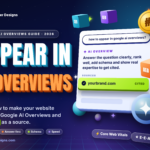
How Do You Appear in Google AI Overviews?
To appear in Google AI Overviews, your page needs to do three things: rank well for the question, answer it clearly near the top, and show signals that Google can trust. Google itself says no special markup or extra technical requirements are needed. Its AI features draw on the same index and quality systems as regular search, so strong SEO fundamentals, including Google Search Essentials, remain the entry ticket.
That is good news. You do not need a new strategy, only a sharper way of packaging the content you already publish. If you want expert help applying these steps to your own site, visit The Dreamer Designs.
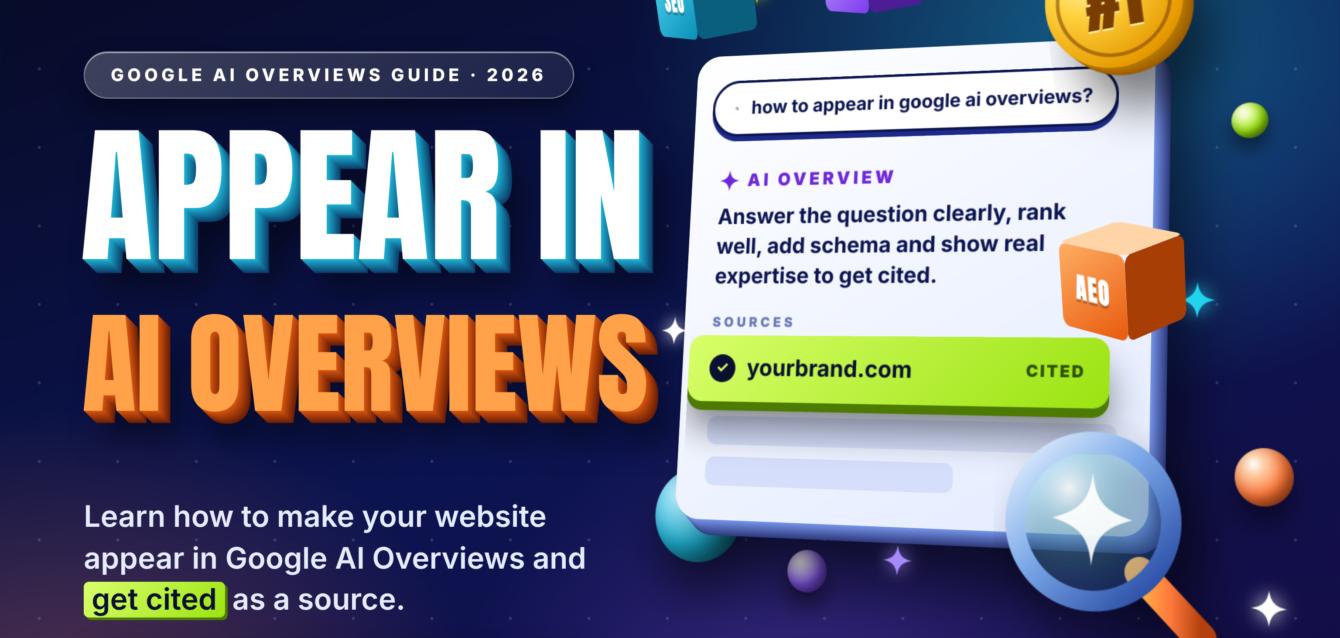
Ranking gets you seen. Being cited gets you chosen. Image by The Dreamer Designs.
What Are Google AI Overviews?
AI Overviews are short AI-written summaries that appear above the normal results for many searches. They pull ideas from several web pages, then link to the sources underneath. Being one of those linked sources puts your brand in front of searchers before they scroll.
They show up most often for informational searches: how-to questions, definitions, comparisons, and “what is” queries. Studies from Ahrefs, Surfer and other SEO platforms report different percentages, because each one samples different keywords. The pattern is the same everywhere, though: question-style queries trigger overviews far more often than short, transactional ones.
8 Steps to Get Your Website Cited in AI Overviews
1. Earn a strong organic ranking first
Pages that get cited are usually pages that already rank well. Research from Semrush found that roughly two-thirds of the URLs inside AI Overviews also sat in the top ten organic results for that search. Fix thin pages, build topical depth, and earn quality backlinks before anything else.
2. Target question-based, long-tail keywords
Use the exact phrasing people type or speak, such as “how do I get my site into AI Overviews?” Put each question in an H2 or H3, then answer it right below. HubSpot’s research also finds that long-tail, conversational queries are where overviews appear most.
3. Write answer-first content
Open each section with a direct answer of 40 to 60 words, then expand with detail, examples, and steps. A summary that makes sense on its own is easy for an AI system to extract and attribute.
4. Structure pages so machines can scan them
Use a clean heading hierarchy, short paragraphs, numbered steps, comparison tables, and bullet lists. One idea per section helps both readers and algorithms.
5. Add relevant structured data
Schema markup such as Article, FAQPage, HowTo, Organization, and Product helps Google understand the entities and topics on your page. Make sure the markup matches the visible content exactly, because mismatches can hurt trust.
6. Build visible E-E-A-T
Show real experience, expertise, authoritativeness, and trust, as described in Google’s guidance on helpful, people-first content:
- Add a named author with credentials and a short bio.
- Cite original data and reputable sources.
- Publish a clear About page, contact details, and editorial policy.
- Keep facts current and show a “last updated” date.
7. Nail the technical basics
AI features rely on Google’s normal crawling and indexing, so a page that cannot be indexed cannot be cited. Check that (see Core Web Vitals for speed targets):
- Googlebot can crawl the page (no accidental noindex or robots.txt block).
- The page loads fast and passes Core Web Vitals.
- The site is mobile-friendly and secure (HTTPS).
- Preview controls such as nosnippet are not limiting what Google can show.
8. Monitor, test, and refresh
The sources Google selects change over time, so treat this as ongoing work, as SE Ranking’s guide also advises. Search your target questions regularly, note which competitors are cited, and compare their structure with yours. After a major update, request reindexing in Google Search Console. Some guides, such as this DEV Community framework, also point to Google’s newer Preferred Sources feature, which lets signed-in users favor sites they trust, so building a loyal audience can help too.
Common Mistakes That Keep Pages Out of AI Overviews
- Burying the answer under a long introduction.
- Stuffing keywords instead of writing naturally.
- Publishing unedited AI text with no original insight.
- Ignoring page speed and mobile usability.
- Using schema that does not match the page.
- Chasing a single trick instead of building real authority.
How to Measure Your AI Overview Visibility
Google Search Console currently reports AI feature traffic within the overall Performance report rather than as a separate line, so combine it with other methods. Track impressions and clicks on your question-style queries, search them manually, and use a rank-tracking tool that records AI Overview citations. Watch branded searches too, since being cited can lift brand awareness even when clicks fall.
Frequently Asked Questions
Do I need to rank on page one to appear in AI Overviews?
Usually yes, or close to it. Most cited pages already rank well for the query, although some lower-ranking pages with a very clear, specific answer can still be included.
Is there a special schema or tag for AI Overviews?
No. Google says no extra technical requirement exists. Standard structured data helps Google understand your content, but it does not guarantee inclusion.
How long does it take to appear in AI Overviews?
There is no fixed timeline. Well-structured pages that are crawled and trusted can appear within weeks, while building consistent visibility across many queries often takes several months.
Can I block my content from AI Overviews?
Yes. Preview controls like nosnippet and max-snippet limit how much of your page Google can show, though they may also reduce your regular search snippets.
Are AI Overviews the same as featured snippets?
No. A featured snippet quotes one source, while an AI Overview combines information from several sources and links to many of them.
Does GEO or AEO replace SEO?
No. Answer engine optimization and generative engine optimization build on SEO. Ranking, quality content, and trust remain the foundation.
Conclusion
Appearing in Google AI Overviews is less about tricks and more about being the clearest, most trustworthy answer to a real question. Rank well, answer directly, structure your content, prove your expertise, and keep your site fast and crawlable. Start with your five most valuable pages, rewrite them in an answer-first format, add matching schema, and track the results. For a deeper dive, read Search Engine Land’s AI Overviews optimization guide, or get hands-on help from The Dreamer Designs.
Get Help From The Dreamer Designs
Want a faster, answer-first website that is ready for AI search? Visit The Dreamer Designs to start your project.