What if snapping your fingers could chop onions perfectly?
Sounds magical, right?
That’s exactly how a lot of AI demos feel today.
You type one sentence, press Enter, and suddenly an entire website appears. Another prompt creates an app. A few words generate a video. Then you watch a 30-second demo and start wondering why anyone would ever need designers, developers, editors, or production teams again.
But if you wouldn’t trust snapping your fingers to perfectly chop the onions for tonight’s dinner, why would you automatically trust one prompt to build your next serious website or application?
That’s the gap between the AI demos we’re watching and the AI workflows we’re actually experiencing.
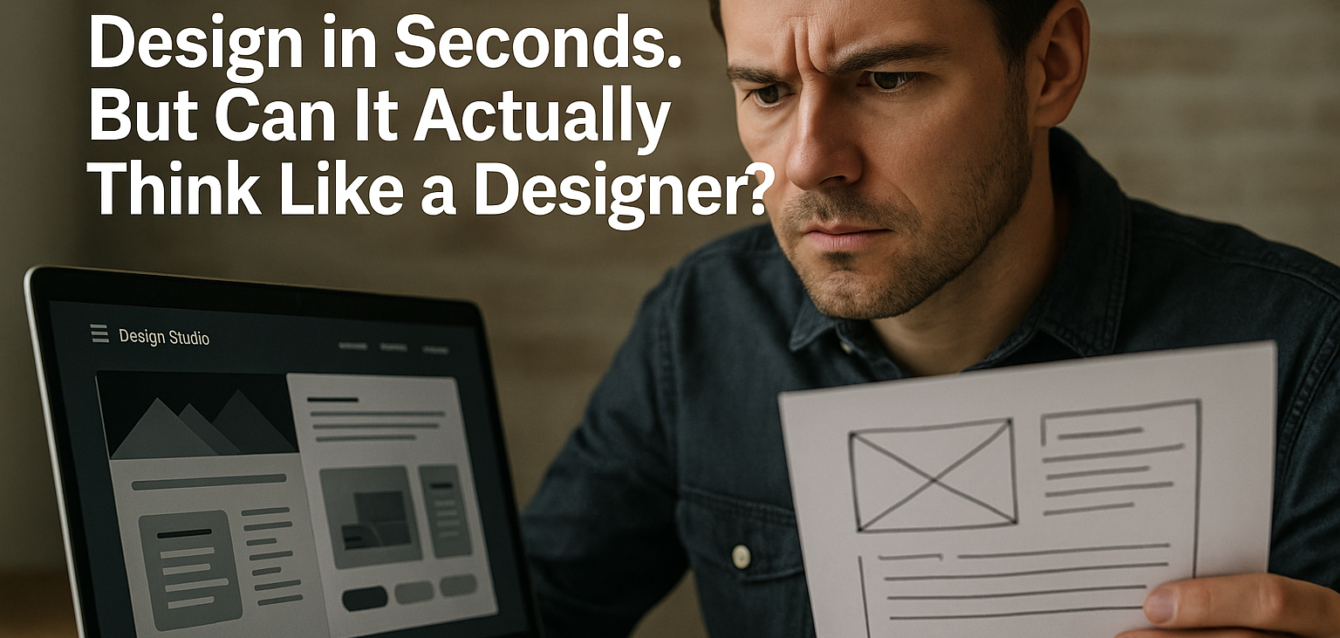
We recently experimented with tools like Google Stitch, and our experience was interesting. On the surface, it feels incredibly powerful. You describe what you want, provide a prompt, and within a short time, you have something visual in front of you.
And yes, it can be impressive.
But is it exactly what you imagined?
Usually, not quite.
For prototyping, early ideation, exploring directions, and quickly turning a rough thought into something visible, these tools can be extremely useful. Something that might previously have taken hours can now be explored in minutes.
That’s genuine progress, and designers shouldn’t ignore it.
The problem isn’t the technology.
The problem is the narrative we’re building around the technology.
Most AI demonstrations show us the perfect scenario. We see the successful prompt, the beautiful output, and the seamless transition from idea to finished product.
We rarely see the 14 prompts that didn’t work.
We don’t see the strange layout that appeared unexpectedly, the component that couldn’t be edited properly, the inconsistent spacing, the responsiveness problems, or the hours spent trying to make one small change without affecting everything else.
And then someone declares:
“Design is dead.”
But design was never simply about producing an output.
Design is thinking.
Design is understanding context.
Design is asking why.
Design is deciding what shouldn’t be there.
Design is understanding the audience, the business, the product, the brand, the technical limitations, and the desired outcome.
And then comes refinement.
That last 10–20% can often be the difference between something that looks impressive in a screenshot and something people can actually use.
AI can assist with all of this. But assistance and complete ownership are still very different things.
The dream workflow we’re often shown looks something like:
Prompt → AI Design → Import to Figma → Generate Code → Push to Cloud → Done.
Beautiful.
In theory, you could go from an idea in your head to a live digital product without needing a traditional design or development process.
In reality, we’re still seeing a lot of fragmentation.
One tool generates the initial concept. Another tool is needed to refine it. Something changes during the transfer. The generated code needs fixing. Responsive behavior needs attention. The design doesn’t quite follow the intended brand system. Then integrations, accessibility, performance, testing, analytics, SEO, conversion optimization, and actual business requirements enter the conversation.
Suddenly, that magical five-step workflow has a lot more steps.
We have noticed something similar while experimenting with AI video tools.
Some of them are genuinely impressive. They can dramatically accelerate ideation and help create things that previously required much more time and production effort.
But again, there is often a gap between “Wow, AI created this!” and “Yes, this is exactly what I wanted.”
They promise the moon.
Sometimes they give you a beautiful glimpse of it.
And that’s still valuable.
The mistake is assuming that because a technology can generate something, it has automatically mastered the discipline behind that thing.
AI makes execution easier, but it can also introduce a new type of uncertainty.
Will the output match the prompt?
Can you reproduce it consistently?
Can you make precise changes?
Can another designer or developer continue working on it?
Will it scale beyond the prototype?
Can it survive real users, real devices, real business requirements, and real client feedback?
Those questions matter much more once you move beyond experimentation.
And that’s why I think this moment is actually an enormous opportunity for designers.
Don’t compete with AI at producing the fastest first draft.
AI will probably win that race.
Instead, become exceptionally good at judgment, strategy, systems, storytelling, user understanding, refinement, and knowing what good actually looks like.
Learn the AI tools too. Use them aggressively where they make sense. Prototype faster. Explore more directions. Automate repetitive tasks. Generate ideas you might never have considered manually.
But don’t confuse faster execution with better thinking.
Tools will keep changing. Today’s revolutionary AI product may become a standard feature inside another platform tomorrow.
The ability to think through a problem will remain valuable.
So yes, AI is powerful.
Yes, it is changing design and development.
And yes, some parts of our existing workflows will probably disappear completely.
But we’re not yet living in a world where one magical prompt consistently takes an idea all the way to a thoughtful, refined, production-ready digital product.
For now, there are still quite a few onions that need chopping.
And in this era of Artificial Intelligence, sometimes it still feels like there’s a little more “Artificial” than “Intelligence.”
#ArtificialIntelligence #AIDesign #GoogleStitch #Figma #ProductDesign #UXDesign #AppDevelopment #WebDesign #NoCode #AItools #DesignThinking #StartupBuilding #FutureOfDesign #GenerativeAI #Designers