Is the AI Bubble About to Burst? Why AI Stocks Crashed This Week
Published November 9, 2026
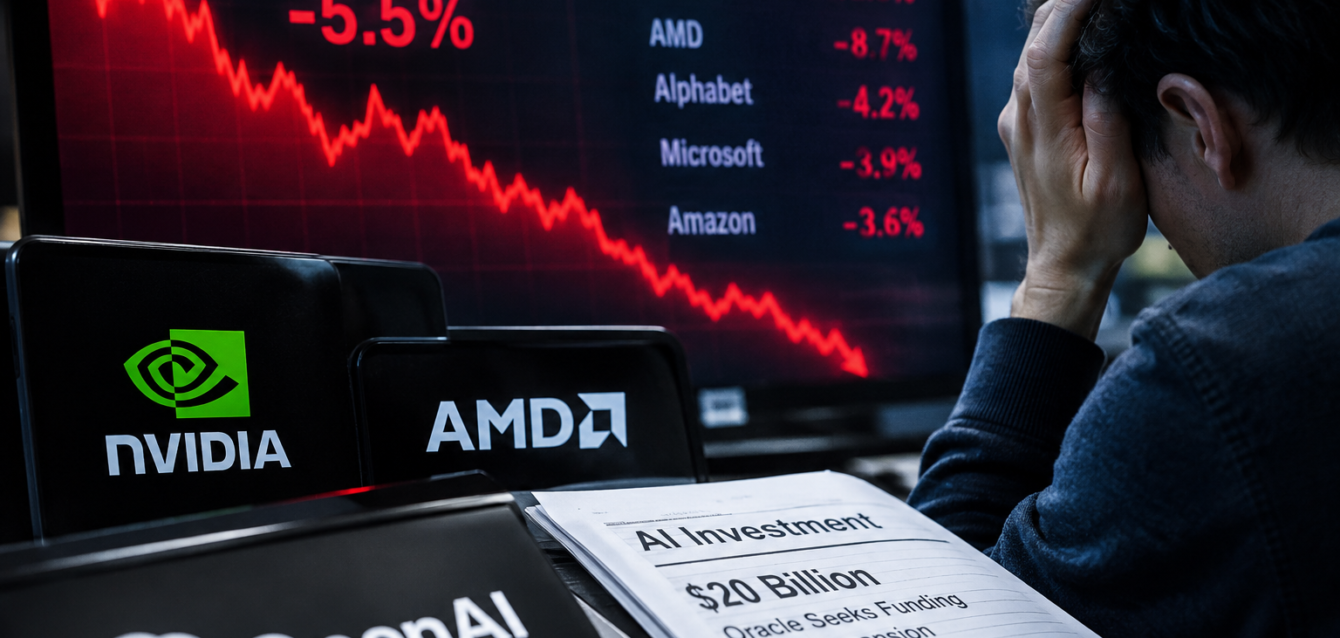
If you opened your investment app this week and felt your stomach drop, you were not alone. The AI stock crash hit on Thursday, when the Nasdaq fell 5.5% in one of its worst sessions in more than a year. Nvidia and AMD took heavy losses, and one market roundup put the damage to the Nasdaq 100 at roughly $2.5 trillion in lost value in a single day.
The question everyone is typing into Google right now: is the AI bubble about to burst?
The honest answer is more interesting than a simple yes or no.
Why did AI stocks crash this week?
The selloff did not come out of nowhere, and it did not come from bad business results. Just a day earlier, AMD had reported record third-quarter revenue of $13.4 billion, with data-center sales up 97%. By any normal measure, that is a blowout.
So why did the stocks fall? Because investors are no longer asking “is AI growing?” They are asking “who is going to pay for all of this, and when?”
Three worries came together at once:
• Sky-high valuations. OpenAI reportedly closed the first $11 billion of a funding round that values the company at $1.25 trillion. Numbers like that leave very little room for disappointment.
• Mounting debt. Oracle is reportedly seeking another $20 billion to fund its AI expansion, and Microsoft is said to be winding down a deal to rent AI capacity from Oracle. When the biggest players start pulling back or borrowing heavily, markets notice.
• Political backlash. Data centers are becoming a political issue. Stocks tied to the Texas build-out fell after the midterm elections, and there is talk of Nvidia’s AI chip exports becoming a target in the new Congress.
Is AI a bubble? The case for yes
Skeptics point to a pattern that looks familiar from past booms such as the dot-com era.
Spending is racing ahead of revenue. Companies are committing staggering sums to computing power. A recent filing showed one leading AI lab with hundreds of billions of dollars in compute commitments, far beyond what it earns today. Even strong revenue growth can look small next to promises that large.
Deals keep getting bigger. Marvell agreed to acquire Lumentum for $115 billion, and investors sold shares in both companies. When the market punishes the buyer and the seller, it suggests nervousness about price tags.
Execution is getting harder. Microsoft is reportedly tightening oversight of specialized cloud providers as construction delays and rising costs complicate the delivery of new capacity. Building data centers is slow and expensive, and delays hurt the economics.
Why the AI bubble may not burst: the case for no
Optimists have real evidence too.
Demand is real. AMD’s data-center sales almost doubled in a year. Companies are not just talking about AI; they are buying the hardware to run it.
Big players are still investing. Even as stocks fell, Google announced a $17 billion AI data-center project. Companies with deep pockets do not usually commit sums like that if they expect demand to vanish.
AI is spreading into everyday work. From cybersecurity tools that find software flaws to AI that speeds up hiring, the technology is showing up in daily business. That kind of adoption is what separates a lasting technology shift from a pure hype cycle.
AI bubble vs. dot-com bubble: a bubble in prices is not a bubble in technology
This is the key distinction most headlines miss.
The dot-com crash wiped out countless stocks, yet the internet itself went on to change the world. A market can be overpriced while the underlying technology is genuinely transformative. Both things can be true at once.
What this week suggests is not that AI is fake. It suggests the market is repricing how fast and how profitably AI will pay off. That is a correction in expectations, and corrections can be painful even when the long-term story is intact.
What the AI stock crash means for investors and workers
If you invest: Be cautious about concentrating your money in a handful of AI-linked stocks. Broad, diversified investing tends to survive swings like this better. This is general information, not financial advice, so consider talking to a qualified advisor about your own situation.
If you work in tech: Expect more volatility, not an end to AI work. Hiring and spending may shift, but demand for AI skills is not disappearing.
If you are just watching: Expect more headlines like this. Big swings are normal in the early years of a major technology wave.
Will the AI bubble burst? The bottom line
AI is not going away, but the era of investors paying any price for anything with “AI” attached may be ending. Whether this week was the start of a deeper burst or just a sharp reset will depend on a simple test: can AI companies turn enormous spending into enormous profits fast enough?
Watch three things in the coming months: whether data-center projects stay on schedule, whether companies can keep raising money without more debt worries, and whether customer revenue grows as fast as the spending.
Those answers, not any single bad week, will tell us whether this is a bubble bursting or a boom catching its breath.
Frequently asked questions about the AI bubble
Is the AI bubble going to burst? Nobody knows. Prices look stretched after this week’s 5.5% Nasdaq drop, but demand is real: AMD’s data-center sales rose 97% in a year. Revenue growth, debt levels and data-center delivery over the next few months will decide it.
Why did AI stocks crash this week? Three worries hit at once: sky-high valuations (OpenAI is reportedly valued at $1.25 trillion), mounting debt (Oracle is reportedly seeking another $20 billion), and political backlash against data centers.
Which AI stocks fell the most? Nvidia and AMD took heavy losses on Thursday. Earlier in the week, CoreWeave fell about 7% and Oracle 4.3%, according to CNBC.
Is the AI bubble like the dot-com bubble? Prices may be overheated in a similar way, but the dot-com crash did not stop the internet from changing the world. A market correction does not mean the technology has failed.
Should I sell my AI stocks? This is general information, not financial advice. Diversified investing tends to handle swings like this better than a concentrated bet, and a qualified advisor can help with your own situation.
Note: market figures are based on news reports from the week of November 2-8, 2026, and may change quickly. This article is for general information and is not investment advice.