
How Headlines Influence CRO Success
How headlines influence CRO success is simple: the headline decides whether visitors understand the offer fast enough to keep reading. A strong headline creates message match, frames the value, reduces confusion, and moves users toward the call to action.
In our audits of 200+ landing pages, unclear landing page headlines are one of the fastest ways to lose qualified traffic. Before changing your full design, run a free CRO audit to see whether your headline, above the fold content, page speed, mobile optimization, trust signals, and form friction are helping or hurting conversions.
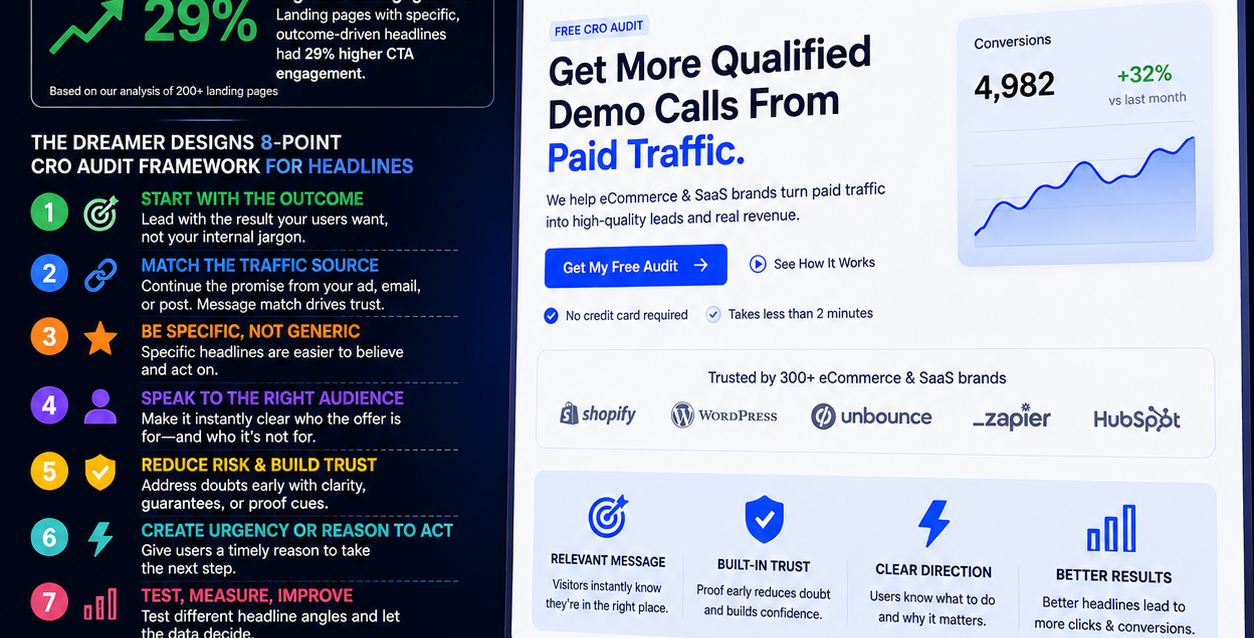
In our analysis of 200+ landing pages, we found that landing pages with specific, outcome-driven headlines had 29% higher CTA engagement than pages with vague brand-led headlines.
What a CRO Headline Does on a Landing Page
A CRO headline tells visitors what the page offers, who it helps, and why they should care. It is not just a title; it is the first conversion argument on the page.
A landing page headline differs from a blog headline. A blog headline earns the click from search results, email, or social. A landing page headline earns the next action after the click. That action might be scrolling, reading proof, clicking a button, filling out a form, adding a product to cart, or booking a call.
According to Nielsen Norman Group, people rarely read web pages word by word; they scan and pick out individual words and sentences. That makes headline CRO critical because the headline is often the first phrase users scan before deciding whether the page is relevant.
A conversion-focused headline should answer three questions quickly:
What is this?
Is it for me?
Why should I keep going?
If the headline does not answer those questions, users must work harder. That extra effort increases bounce rate and weakens the conversion funnel before the offer has a chance.
Why Headlines Influence CRO Success So Strongly
Headlines influence CRO success because they shape relevance before users evaluate design, proof, pricing, or features. If the headline feels unclear, the rest of the landing page has to fight against that first doubt.
The headline controls the first impression above the fold. It tells users whether the page matches the ad, search query, social post, or email they clicked. This is why message match matters so much. If a Google Ads headline promises “Free Shopify CRO Audit,” but the landing page headline says “Grow Your Brand With Better Design,” the visitor feels a disconnect.
CXL’s landing page guidance emphasizes that high-converting landing pages need clear structure, persuasive copy, and copy-first planning before design. That aligns with our CRO process: we write the conversion argument before polishing the layout.
Headlines also influence user behavior signals. A clear headline can improve scroll depth, click-through rate, CTA engagement, form starts, and ecommerce conversion. A weak headline can make users scan randomly, ignore social proof, miss the offer, or abandon the page before watching a video, reading a testimonial, or checking pricing.
For Shopify, WordPress, and Unbounce pages, headline clarity is often the fastest CRO fix because it does not require rebuilding the full page. A stronger headline can improve landing page optimization before deeper A/B testing, split testing, or multivariate testing begins.
The Dreamer Designs 8-Point CRO Audit Framework for Headlines
The Dreamer Designs 8-Point CRO Audit Framework helps evaluate headlines as conversion tools, not creative slogans. The goal is to make every headline clear, relevant, believable, and testable.
1. Start with the user’s desired outcome
A strong headline should lead with the outcome the user wants, not the internal language your company uses. “Get More Qualified Demo Calls From Paid Traffic” is clearer than “Scale Revenue With a Smarter Growth Engine.” The first headline gives users a concrete result. The second sounds polished but vague.
For headline CRO, start by naming the visitor’s goal. For ecommerce conversion, that goal might be better skin, faster meal prep, or more comfortable shoes. For lead generation, it might be more calls, lower acquisition cost, or a faster quote. Quick win: rewrite your headline around the phrase “Get [specific result] without [specific pain].”
2. Match the headline to the traffic source
A landing page headline should continue the exact promise that earned the click. This is message match. It tells users they arrived in the right place.
For paid search, use the keyword or offer angle in the headline. For paid social, match the pain point or desire from the creative. For email, repeat the campaign promise. For a retargeting ad, speak to the objection that kept users from converting the first time. Quick win: compare your ad headline, landing page headline, and CTA copy in one view. If they feel like three different campaigns, tighten the message.
3. Make the value specific enough to believe
Specificity makes a headline easier to trust. “Improve Your Landing Page Conversion Rate” is useful. “Find the 8 Fixes Blocking More Leads From Your Landing Page” is stronger because it gives users a clear reason to continue.
Trust signals and social proof work better when the headline sets up a believable promise. A case study, review count, or guarantee cannot fully save an inflated claim. Quick win: remove broad words like “best,” “ultimate,” “innovative,” and “powerful” unless the page immediately proves them. Replace them with numbers, outcomes, use cases, or audience-specific benefits.
4. Keep the headline short enough to scan
Users scan, so long headlines often lose impact. Nielsen Norman Group’s web reading research shows that concise, scannable, and objective writing can improve usability, which matters because usability supports conversion behavior.
A landing page headline should usually fit into one clear thought. It can be benefit-led, problem-led, or proof-led, but it should not try to explain every feature. Quick win: if your headline needs two commas, a colon, and a subheadline to make sense, simplify it. Use the headline for the core promise and the subheadline for context.
5. Use the subheadline to remove doubt
The headline earns attention. The subheadline should add clarity, proof, or context. If the headline says “Turn More Paid Clicks Into Leads,” the subheadline can explain how: “Get a CRO audit that reviews your headline, CTA, page speed, trust signals, and form friction in minutes.”
This is where landing page copywriting becomes conversion strategy. The subheadline can clarify the audience, timeline, mechanism, or next step. Quick win: write the subheadline as a direct answer to the question, “How does this work?” Then place it close enough to the headline that users read both together.
6. Align the headline with the CTA
Your headline and call to action should feel like one connected thought. If the headline promises a free checklist, the CTA should say “Get the Free Checklist,” not “Submit.” If the headline promises an audit, the CTA should say “Run My Free Audit.”
CTA mismatch creates small friction that can reduce click-through rate. The user has to translate the promise into an action. Quick win: repeat the offer language in the CTA so the next step feels obvious. A custom landing page should make the headline, CTA, proof, and form work as one conversion path.
7. Validate headline clarity with behavior data
A headline may sound clear in a meeting but fail with real users. Use a heatmap and session recording to see whether visitors pause, scroll, click the CTA, or leave quickly. Microsoft Clarity offers heatmaps and session replays that can help teams understand how users behave on a page.
Quick win: watch five mobile recordings from users who bounced. If they land, pause, scroll slightly, and leave without clicking, the headline may not be making the page relevant fast enough.
8. Test headlines as CRO hypotheses
Headline testing works best when each variant is tied to a clear hypothesis. Do not test random word choices. Test different conversion arguments.
For example, one headline may lead with outcome: “Get More Demo Calls From Paid Search.” Another may lead with pain: “Stop Losing Paid Search Leads to Weak Landing Pages.” Another may lead with proof: “The CRO Audit Used on 200+ Landing Pages.” Use A/B testing for focused headline variants and multivariate testing only when traffic volume can support more complex tests. Quick win: track CTA clicks, form starts, bounce rate, and key events in Google Analytics 4, where Google allows teams to create and modify events around important user actions.
How Headlines Influence CRO Success Across Different Landing Pages
Headlines influence CRO success differently depending on the offer, audience, and conversion goal. The best headline is not the cleverest one; it is the one that makes the next decision easier.
SaaS headlines need to clarify the product outcome
SaaS visitors need to understand the category, benefit, and use case quickly. A headline like “Customer Support Software for Faster Ticket Resolution” is stronger than “The Future of Customer Experience.” The first headline tells users what the product does. The second requires interpretation.
For SaaS landing pages, use headline testing to compare outcome-driven, pain-driven, and product-led versions. Pair the headline with product screenshots, customer logos, trust signals, and a CTA such as “Start Free Trial” or “Book a Demo.” A clear headline can reduce form friction because users know what they are signing up for.
Ecommerce headlines need to connect desire and confidence
Ecommerce headlines should make the product’s value easy to understand. On Shopify pages, the headline must often compete with product photos, price, reviews, and discount messaging. If the headline is vague, users may scroll without understanding why the product is different.
A strong ecommerce headline might lead with the product’s core result, such as “Cleaner Protein Bars Without the Sugar Crash” or “Supportive Running Shoes Built for Long Workdays.” Pair the headline with reviews, ratings, shipping details, and secure checkout cues. This helps connect desire with purchase confidence.
Lead generation headlines need to reduce risk
Lead generation pages ask users to give personal information, so the headline must make the value of that exchange clear. “Book a Free Strategy Call” is common, but it is not always persuasive. “Find the 3 Fixes Blocking More Qualified Leads” gives users a clearer reason to act.
For lead generation, the headline should pair with privacy reassurance, process clarity, response time, and social proof. If the form is above the fold, the headline must make the form feel worth completing.
WordPress service page headlines need to avoid broad claims
WordPress service pages often use homepage-style language that is too broad for landing page CRO. Headlines like “We Build Digital Experiences That Convert” sound professional, but they do not explain the service, audience, or outcome.
A stronger version might say, “Custom WordPress Landing Pages Built to Turn Ad Traffic Into Leads.” This gives users context and supports message match. It also helps the page connect with SEO intent and conversion intent at the same time.
Unbounce headlines need tight campaign alignment
Unbounce pages are often built for paid campaigns, which makes headline alignment even more important. The page must reflect the campaign keyword, audience, and offer immediately.
If the ad targets “free CRO audit,” the Unbounce headline should not lead with a general agency statement. It should repeat the audit promise and show why it is worth completing. A dedicated Unbounce page builder workflow can help align the headline, CTA, hero layout, page speed, and split testing plan around one conversion goal.
Headline CRO Mistakes That Lower Landing Page Conversions
Most headline mistakes happen when teams write for brand preference instead of user clarity. A headline should reduce confusion, not make the visitor decode the offer.
Choosing cleverness over clarity
Clever headlines can work when the audience already understands the brand and offer. On most landing pages, clarity wins. A headline like “Make Every Click Count” may sound strong, but it does not tell users what the product or service does.
Fix it by making the headline literal first, then adding personality only if clarity remains. If a first-time visitor cannot explain the offer after reading the headline, the copy is not ready for CRO testing.
Leading with the company instead of the customer
Many headlines start with “We help,” “Our platform,” or “The agency built for.” That can work, but it often keeps the focus on the business instead of the user’s goal.
Fix it by making the user the subject of the headline. “Turn More Paid Traffic Into Qualified Leads” is stronger than “We Build High-Converting Landing Pages” because it starts with the result the user wants.
Making a claim the page cannot prove
A headline that promises too much can damage trust. “Double Your Revenue in 30 Days” may create attention, but if the page does not prove it, visitors may feel skeptical.
Fix it by pairing bold claims with proof. Use case study metrics, customer counts, testimonials, review ratings, or process details. If you cannot prove the claim, make it more specific and believable.
Ignoring mobile headline length
A headline that looks clean on desktop can become six lines on mobile. That can push the CTA, social proof, or form below the fold and weaken mobile optimization.
Fix it by reviewing headline length on real devices. Shorten phrases, remove filler words, and check whether the CTA remains visible. Mobile users should see the core promise without fighting the layout.
Testing too many headline ideas at once
Headline testing fails when teams change the headline, subheadline, CTA, hero image, and form at the same time. If the page improves, no one knows which change caused the lift.
Fix it by testing one major conversion argument at a time. Compare benefit-led versus pain-led headlines, or specific versus broad headlines. Use the conversion rate optimization tool to connect testing ideas with user behavior and funnel performance.
Copying competitor headlines without context
Competitor headlines may look polished, but they are built for a different audience, traffic source, offer, and conversion funnel. Copying them can create weak message match.
Fix it by studying competitors for patterns, not templates. Identify what they emphasize, then write a headline based on your own audience, proof, and offer.
CRO Tools That Help Improve Landing Page Headlines
Headline optimization works best when you combine audit insight, behavior data, analytics, and testing. Tools help you move from opinion to evidence.
The Dreamer Designs CRO Analyzera should be the first tool you use because it reviews headline clarity alongside CTA visibility, above the fold layout, trust signals, page speed, mobile optimization, and form friction. It helps you see whether the headline is creating a clear path to conversion.
Google Analytics 4 helps measure headline performance indirectly through events and key actions. Use it to track CTA clicks, form starts, generate_lead events, purchases, and other key events after headline changes. Google’s documentation explains that events can be created and modified to measure what matters.
Microsoft Clarity helps you understand whether users engage after reading the headline. Use heatmap data, scroll behavior, and session recording clips to see whether users bounce, hesitate, rage click, or move toward the CTA.
Google PageSpeed Insights matters because even a strong headline cannot convert if it appears slowly. Use it to check whether Core Web Vitals, render-blocking resources, and page speed issues delay the first screen.
Unbounce can support headline testing with landing page building, no-code A/B testing, analytics, and optimization tools. Unbounce describes its platform as built for marketers and agencies with no-code A/B testing and real-time analytics.
CXL is useful for CRO strategy and landing page thinking. One recent CXL landing page article summarizes the B2B landing page play as matching message to intent, proving value fast, removing friction, and making the next step feel obvious.
Questions Marketers Ask About Headlines and CRO
These are the questions founders, marketers, ecommerce teams, and SaaS teams often ask before rewriting a landing page headline.
How do headlines affect conversion rate?
Headlines affect conversion rate by shaping relevance, clarity, and trust in the first few seconds. If visitors understand the offer quickly, they are more likely to scroll, click the CTA, start a form, or continue through the conversion funnel. If the headline is vague, users may bounce before seeing social proof, pricing, testimonials, or product details.
What makes a good landing page headline?
A good landing page headline is clear, specific, benefit-driven, and matched to user intent. It should tell visitors what the offer is, who it helps, and why it matters. Strong landing page headlines avoid vague language and focus on outcomes. They also work with the subheadline, call to action, trust signals, and above the fold design.
Should landing page headlines be short or long?
Landing page headlines should be as short as possible while still being specific. A short vague headline is not better than a longer clear headline. For headline CRO, the goal is fast understanding. On mobile, shorter headlines usually work better because they protect CTA visibility and reduce layout crowding. Test length against click-through rate, scroll depth, and conversions.
What is headline testing in CRO?
Headline testing in CRO means comparing different headline versions to see which one improves user behavior and conversions. You can test benefit-led, pain-led, proof-led, or audience-specific headlines. Use A/B testing when traffic is strong enough and track CTA clicks, form starts, bounce rate, and key events. Headline testing should test a hypothesis, not random wording.
How many headlines should I test at once?
Most landing pages should test two headline variants at a time unless traffic volume is high. Testing too many headlines can slow learning and create unclear results. Start with your current headline as the control and one stronger alternative. For high-traffic pages, multivariate testing can compare headline, subheadline, CTA, and proof combinations.
How do I write a headline for a lead generation landing page?
Write a lead generation headline around the value of the exchange. Users are giving their information, so the headline should explain what they get in return. Use specific outcomes such as “Find the 5 Fixes Blocking More Demo Requests” instead of generic copy like “Book a Free Consultation.” Add privacy reassurance and social proof near the form to reduce form friction.
How do ecommerce headlines improve CRO?
Ecommerce headlines improve CRO by connecting the product to the customer’s desired result. A strong Shopify headline explains why the product is useful, different, or worth buying now. Pair it with reviews, ratings, product photos, return policy details, and secure checkout cues. This helps users move from interest to purchase with less hesitation.
Should my headline include keywords?
Yes, your headline can include keywords when they match user intent naturally. For SEO landing pages, keyword alignment helps users confirm they reached the right page. For paid campaigns, repeating the search term or offer can improve message match. Do not force keywords into the headline if they make the copy awkward or less persuasive.
What is the difference between a headline and a subheadline?
The headline delivers the main promise. The subheadline adds detail, proof, or context. For example, the headline might say “Turn More Paid Clicks Into Leads,” while the subheadline explains, “Get a free CRO audit that checks your headline, CTA, trust signals, page speed, and form friction.” Together, they should make the page easier to understand.
How do I know if my headline is hurting conversions?
Your headline may be hurting conversions if bounce rate is high, CTA clicks are low, scroll depth is weak, or session recordings show users pausing and leaving quickly. Use a heatmap, Google Analytics 4, and A/B testing to compare headline performance. If users do not understand the offer above the fold, the headline needs work.
Strong Headlines Make the Next Step Feel Obvious
How headlines influence CRO success comes down to clarity, relevance, and confidence. The headline is where users decide whether the page matches their intent and whether the offer is worth more attention.
A high-converting headline does not try to sound clever first. It explains the outcome, matches the traffic source, supports the CTA, and works with social proof, trust signals, page speed, mobile optimization, and landing page copywriting. When the headline is clear, the rest of the page has a better chance to persuade.
In our audits of 200+ landing pages, headline improvements often create faster wins than full redesigns because they fix the first point of confusion. Start with the top screen, test one conversion argument at a time, and measure behavior before making bigger changes.
To find out whether your headline is helping or blocking conversions, run a free audit.