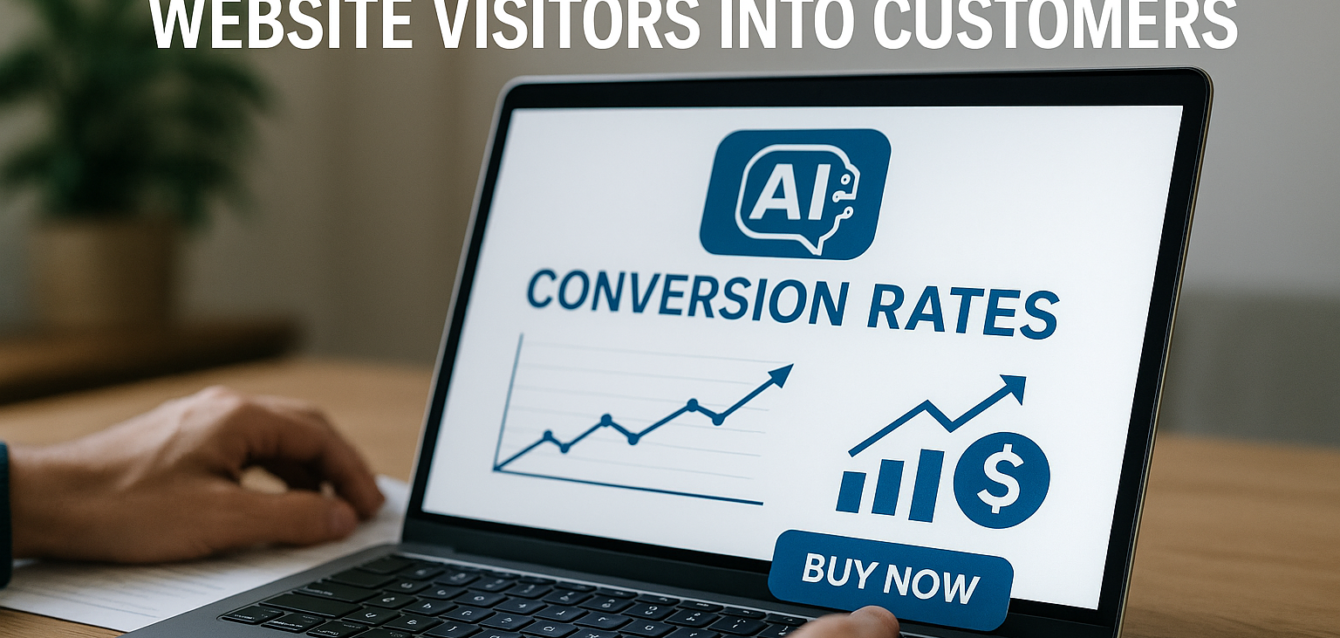
Getting people to visit your website is only half the battle. The real challenge is turning those visitors into leads, subscribers, booked calls, or paying customers.
Businesses often invest heavily in SEO, paid advertising, social media, and content marketing to increase website traffic. But if visitors arrive and leave without taking action, more traffic simply means more missed opportunities.
This is where artificial intelligence (AI) can make a significant difference.
AI can help businesses understand visitor behavior, personalize website experiences, improve landing pages, optimize calls to action, automate conversations, and identify conversion problems faster. Instead of guessing what visitors want, businesses can use data and AI-powered insights to make smarter decisions.
The goal isn’t to fill your website with AI features. The goal is to use AI strategically to remove friction and make it easier for visitors to become customers.
1. Use AI to Understand Why Visitors Aren’t Converting
Before trying to increase conversions, understand what is stopping them.
Traditional website analytics can tell you how many people visited a page, how long they stayed, and whether they converted. AI-powered analytics can go further by helping identify behavioral patterns across thousands of visitor sessions.
For example, AI can help uncover whether visitors are:
Leaving important landing pages too quickly Ignoring your primary call to action
Abandoning forms halfway through Struggling with navigation Dropping off on mobile devices Repeatedly visiting pricing pages without converting Leaving at a particular stage of the buying journey These insights give marketing teams a clearer starting point.
Instead of saying, “We need more traffic,” you can ask a more valuable question:
“Why isn’t our existing traffic converting?”
That shift is fundamental to conversion rate optimization.
2. Create More Relevant Website Experiences
Not every visitor arrives with the same intention.
Someone discovering your company through a blog post may need educational content. A visitor coming from a Google Ads campaign may already be comparing solutions. Someone returning to your pricing page for the third time may be much closer to making a decision.
Showing all three visitors exactly the same experience can limit conversions.
AI-powered personalization can help websites adapt content based on signals such as traffic source, previous interactions, browsing behavior, location, device, or stage of the customer journey.
Personalization might involve changing:
Headlines
Calls to action
Product recommendations
Featured case studies
Offers
Landing-page messaging
Recommended content
The objective is simple: show people information that is more relevant to what they are trying to accomplish.
Relevant experiences reduce the amount of work visitors have to do before understanding whether your business can help them.
3. Improve Website Copy With AI
Website copy plays a major role in conversion.
Visitors should quickly understand what you offer, who it is for, why it matters, and what they should do next.
AI can help marketing teams analyze and improve headlines, subheadings, product descriptions, landing-page content, calls to action, and form messaging.
For example, instead of using a generic headline such as:
“Innovative Solutions for Modern Businesses”
AI can help explore clearer, benefit-focused alternatives that explain the actual outcome being offered.
AI is particularly useful for generating multiple messaging variations quickly.
However, AI-generated copy shouldn’t automatically become your final website copy. Human review remains essential.
Your team understands your positioning, customer conversations, brand personality, competitive advantages, and business objectives better than a generic AI model.
Use AI to accelerate exploration—not replace strategic thinking.
4. Optimize Calls to Action
Small CTA changes can sometimes create meaningful conversion improvements.
AI can help generate and evaluate different CTA variations based on visitor intent.
Instead of automatically using:
“Learn More”
you might test more specific alternatives such as:
“Get My Free Website Audit”
“See How It Works”
“Book a Strategy Call”
“Start My Free Trial”
“Get a Custom Quote”
The best CTA depends on what the visitor expects to happen next.
AI can accelerate experimentation by generating variations, organizing test ideas, and analyzing performance data. Combined with A/B testing, this allows teams to continuously improve important conversion points.
5. Use AI Chatbots to Answer
Questions Instantly
Visitors often leave websites because they cannot find the information they need quickly enough. They might have questions about pricing, delivery, features, availability, compatibility, services, timelines, or policies.
An AI chatbot can provide immediate assistance without requiring someone from your team to manually answer every basic question.
Modern AI assistants can be trained or grounded on approved business information such as:
Website content
Product documentation
FAQs
Knowledge bases
Service information
Company policies
A useful chatbot shouldn’t simply generate responses. It should help visitors move forward.
For example, after answering a service question, it might direct the visitor to a relevant case study or booking page.
When the conversation becomes more complex, the system should also know when to hand the visitor over to a human.
6. Make Forms Easier to Complete
Forms are one of the most important conversion points on many websites.
They’re also one of the easiest places to lose potential customers.
Long forms, unnecessary questions, confusing labels, technical errors, and poor mobile experiences can dramatically increase friction.
AI-assisted analysis can help identify where users abandon forms and which fields may be causing problems.
It can also help teams rethink what information actually needs to be collected. For a first interaction, do you really need 12 fields?
Sometimes a name, email address, and one qualifying question are enough.
Additional information can be collected later.
The easier it is for visitors to take the first step, the more likely they are to do it.
7. Use Predictive Insights to Identify High-Intent Visitors
Not every website visitor has the same likelihood of becoming a customer.
AI can analyze behavioral signals to help identify visitors or leads showing stronger buying intent. Signals might include repeated visits, specific page combinations, pricing-page activity, downloads, product interactions, or previous engagement.
Businesses can use these insights to prioritize follow-ups or trigger appropriate next steps.
A high-intent visitor might receive an invitation to schedule a consultation, while an early-stage visitor might receive educational resources.
This creates a more intelligent customer journey than treating every visitor identically.
8. Improve Product and Content Recommendations
For websites with many products, services, resources, or articles, visitors can easily become overwhelmed.
AI-powered recommendation systems can help users discover relevant options based on their interests and behavior. An e-commerce website might recommend complementary products.
A SaaS website might suggest the most relevant feature page or case study.
A service business might guide visitors toward the solution that best matches their challenge. Good recommendations reduce decision fatigue and shorten the path between discovery and conversion.
9. Analyze Landing Pages Faster
Landing-page optimization traditionally requires marketers to manually review headlines, CTAs, forms, layouts, trust signals, and analytics.
AI can accelerate this process.
AI-powered website analysis can help identify potential issues involving:
Message clarity
CTA visibility
Form friction
Content hierarchy
Mobile usability
Trust signals
Page structure
Conversion distractions
AI shouldn’t be treated as an automatic authority on design or conversion strategy.
Instead, it can act as a fast first layer of analysis that helps teams identify areas worth investigating.
That allows marketers and designers to spend more time testing improvements rather than manually searching for every possible issue.
10. Turn Conversion Optimization Into a Continuous Process
One of AI’s biggest advantages is speed.
Website optimization shouldn’t happen once every two years during a redesign.
Customer expectations change. Traffic sources change. Competitors change. Products evolve. Offers change.
Your website should evolve too.
AI can help teams continuously analyze performance, generate hypotheses, identify unusual behavior, summarize experiments, and discover potential opportunities.
The process becomes:
Analyze → Identify friction → Create hypothesis → Test → Measure → Improve → Repeat
Instead of redesigning based on opinions, businesses can build a culture of continuous experimentation.
AI Should Support Human Decision-Making
AI can analyze enormous amounts of information quickly, but conversion optimization still requires human judgment.
AI doesn’t automatically understand your customers, positioning, brand promises, operational limitations, or long-term strategy.
The strongest approach combines both. AI provides speed, pattern recognition, automation, and scale.
Humans provide strategy, empathy, creativity, context, and judgment.
The question therefore shouldn’t be:
“How can AI replace our marketing team?”
A better question is:
“How can AI help our team understand customers and improve their experience faster?”
Turn More of the Traffic You Already Have Into Customers
Businesses often assume growth requires more website visitors.
Sometimes it does.
But before spending more on advertising or SEO, look carefully at what happens after people arrive.
If 10,000 visitors generate 100 customers, increasing traffic isn’t your only growth opportunity. Improving the percentage of existing visitors who convert can create significant gains without proportionally increasing acquisition costs.
AI gives businesses new ways to understand behavior, personalize experiences, improve messaging, automate assistance, analyze landing pages, and identify conversion opportunities.
But the objective remains surprisingly human:
Understand what people need and make it easier for them to take the next step.
Use AI where it removes friction. Use automation where it improves speed. Use data where it improves decisions.
And keep humans involved wherever context, creativity, empathy, and strategic judgment matter.
That’s how AI becomes more than another website trend.
It becomes a practical tool for turning more website visitors into customers.
#AIwebsiteoptimization #AIconversionrateoptimization #websiteconversionoptimization #AImarketingtools #conversionrateoptimization #CROstrategy #AIwebsitepersonalization #AIchatbotsforwebsites #landingpageoptimization #websitevisitorconversion #AIleadgeneration #customerjourneyoptimization #AImarketingautomation #websiteconversionrate #AI-poweredCRO