
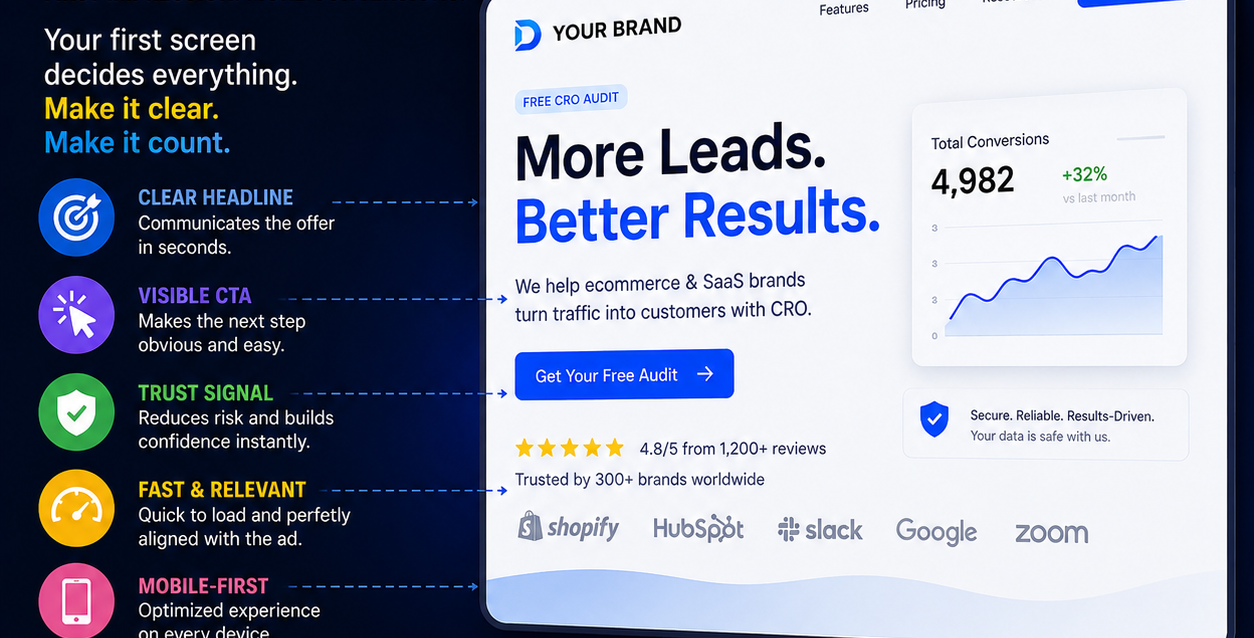
How Headlines Drive Conversions in CRO
How headlines drive conversions in CRO is simple: the headline is the first promise users judge after they land. If it matches their intent, explains the value, and makes the next step feel relevant, more visitors stay, scroll, click, and convert.
In our audits of 200+ landing pages, we often see strong offers fail because the headline is too vague, too clever, or disconnected from the ad that brought the visitor there. Before redesigning the whole page, run a free CRO audit to see whether your headline, above the fold content, call to action, page speed, trust signals, mobile optimization, and form friction are working together.
In our analysis of 200+ landing pages, we found that pages with clear, outcome-led headlines had 32% higher CTA engagement than pages with vague brand-led headlines.
What a CRO Headline Is Supposed to Do
A CRO headline is the first conversion argument on a landing page. Its job is to make the visitor understand the offer, feel the page is relevant, and want to continue.
A headline is not just a creative line at the top of the page. It is the first filter in the conversion funnel. It tells visitors whether they are in the right place, whether the offer solves their problem, and whether the next action is worth their time.
According to Nielsen Norman Group, users often scan web pages instead of reading every word, which makes the first visible copy especially important for clarity and usability.
A strong conversion-focused headline usually answers three questions quickly:
What is being offered?
Who is it for?
What result does it help me get?
For example, “Get More Qualified Demo Calls From Paid Search” is stronger than “Scale Smarter With Better Marketing.” The first headline is specific. The second headline sounds polished, but it does not give the user enough information to act.
CRO headlines should also support the rest of the page. The headline, subheadline, visual, CTA, social proof, and trust signals should feel like one clear story. When those pieces are disconnected, users have to work harder. That extra effort can increase bounce rate and lower click-through rate.
Why Headlines Drive Conversions in CRO
Headlines drive conversions in CRO because they shape the user’s first decision: stay or leave. Before users evaluate testimonials, pricing, features, forms, or design details, they decide whether the headline feels relevant.
The headline carries the weight of message match. If someone clicks an ad for a “free landing page audit,” the page should not open with “Build Better Digital Experiences.” That creates friction. A better headline would say, “Find the Fixes Blocking More Landing Page Conversions.” It keeps the promise connected to the click.
CXL explains that a strong value proposition is one of the most important conversion factors because it gives users the reason to buy or act. A headline is often the clearest expression of that value proposition above the fold.
Headlines also drive conversions by making the CTA feel logical. A CTA like “Run My Free Audit” works better when the headline has already made the audit feel useful. If the headline is unclear, the CTA feels like a jump. If the headline is clear, the CTA feels like the obvious next step.
For Shopify, WordPress, and Unbounce landing pages, headline clarity is often one of the fastest landing page optimization wins. You can improve the first impression without changing the entire layout. Then you can validate the change with A/B testing, heatmap data, session recording clips, Google Analytics 4 events, and headline testing.
The Dreamer Designs 8-Point CRO Audit Framework for Headlines
The Dreamer Designs 8-Point CRO Audit Framework looks at headlines as part of the full decision path. The goal is not to write a clever line. The goal is to create a headline that helps users move forward.
1. Lead with the outcome users want
A headline should start with the result the visitor cares about. Users rarely arrive thinking, “I need a better interface.” They think, “I need more leads,” “I need more sales,” “I need fewer abandoned carts,” or “I need more demo requests.”
That is why outcome-led CRO headlines usually beat broad brand statements. “Turn More Paid Clicks Into Qualified Leads” gives the user a clear reason to continue. “Performance Marketing Solutions for Modern Teams” is less direct.
Quick win: write your headline using this simple frame: “Get [specific result] without [specific pain].” For example, “Get More Shopify Sales Without Rebuilding Your Store” is clear, specific, and tied to ecommerce conversion.
2. Match the headline to the traffic source
Message match is one of the strongest ways headlines drive conversions in CRO. The visitor should see a clear connection between the ad, search result, email, social post, or referral link they clicked and the landing page headline.
If a Google Ads campaign targets “Unbounce landing page design,” the headline should reflect that exact intent. If a Meta ad promotes a free checklist, the headline should mention the checklist. If an email campaign promises faster lead generation, the headline should continue that promise.
Quick win: place your ad headline, landing page headline, and CTA copy side by side. If they sound like three different campaigns, rewrite them until they feel connected.
3. Use the subheadline to remove doubt
The headline should make the promise. The subheadline should explain the mechanism, audience, proof, or next step.
For example, the headline might say, “Find the Fixes Blocking More Landing Page Leads.” The subheadline could say, “Get a CRO audit that reviews your headline, CTA, above the fold layout, page speed, trust signals, and form friction.”
This pairing works because the headline creates interest, while the subheadline builds clarity. In landing page copywriting, the subheadline should never repeat the headline in softer words. It should add useful information.
Quick win: after writing your headline, ask, “What would a skeptical visitor ask next?” Use the subheadline to answer that question.
4. Make the first CTA feel like the natural next step
A headline and call to action should work together. If the headline promises an audit, the CTA should mention the audit. If the headline promises a guide, the CTA should mention the guide. If the headline promises a demo, the CTA should make demo booking clear.
Weak CTA alignment creates small but costly friction. A headline that says “Improve Your Landing Page Conversion Rate” followed by a button that says “Submit” wastes momentum. A better CTA would say “Run My Free Audit” or “Get My CRO Review.”
Quick win: repeat the offer language from the headline inside the CTA. A professional landing page should make the headline, CTA, proof, and form feel like one clear path.
5. Add proof near the headline
A headline makes a claim. Trust signals help users believe it.
Proof near the headline can include review counts, client logos, star ratings, case study results, customer counts, certifications, security cues, or short testimonials. Social proof is especially useful above the fold because users judge credibility before they scroll.
For example, “Used by 300+ ecommerce and SaaS teams” can make a headline feel more credible. “4.8-star rating from 1,200 customers” can support ecommerce conversion. “Built from audits of 200+ landing pages” can support a CRO offer.
Quick win: place one proof cue within visual range of the headline and first CTA. Then compare CTA engagement before and after the change.
6. Protect the headline with page speed and mobile layout
Even the best headline cannot drive conversions if users do not see it quickly. Heavy hero images, custom fonts, animation scripts, and slow third-party tools can delay the first screen.
Google explains that Core Web Vitals measure real-world user experience for loading performance, interactivity, and visual stability. Those metrics matter because the headline and CTA often live in the first screen users judge.
Mobile optimization matters just as much. A headline that looks sharp on desktop can become too long on mobile, pushing the CTA and social proof below the fold.
Quick win: test your page with Google PageSpeed Insights and review the headline on real mobile devices. Make sure the headline, subheadline, CTA, and one proof cue appear quickly.
7. Validate headline clarity with behavior data
Internal teams often think a headline is clear because they already understand the offer. New visitors do not have that context.
Use Microsoft Clarity or a similar behavior tool to review a heatmap, scroll data, and session recording clips. Microsoft Clarity describes itself as a free user behavior analytics tool with heatmaps and session replays, which makes it useful for spotting hesitation and confusion.
Look for signs that the headline is not doing its job. Users may land, pause, scroll slightly, click nothing, and leave. They may tap non-clickable elements. They may jump straight to pricing because the value is unclear.
Quick win: watch five mobile recordings from users who bounced. If they do not engage with the CTA or scroll into proof, rewrite the headline before redesigning the page.
8. Test one headline hypothesis at a time
Headline testing should compare different conversion arguments, not random wording changes.
For example, you might test:
Outcome-led: “Turn More Paid Clicks Into Qualified Leads”
Pain-led: “Stop Losing Paid Traffic to Weak Landing Pages”
Proof-led: “The CRO Audit Framework Used on 200+ Landing Pages”
Audience-led: “Landing Page CRO for Shopify and SaaS Teams”
Each version makes a different argument. A/B testing can show which argument moves users forward. Split testing works well for bigger page variations. Multivariate testing can work for high-traffic pages, but it needs enough volume to avoid misleading results.
Quick win: track CTA clicks, form starts, bounce rate, and conversion rate in Google Analytics 4. Do not judge headline performance by button clicks alone if the final conversion does not improve.
Headline Formulas That Improve Landing Page Conversion
Headline formulas help teams write faster, but they should not replace research. The best formula is the one that matches the user’s intent and stage of awareness.
The outcome headline
An outcome headline leads with the result users want.
Example: “Get More Qualified Leads From Your Landing Page”
This works well for lead generation, SaaS, and service pages because it connects directly to the business result. Use this when visitors already know the problem and want a better outcome.
The problem headline
A problem headline names the pain users want to solve.
Example: “Your Landing Page Is Getting Clicks, But Not Enough Leads”
This works when visitors are problem-aware but may not know what is causing the issue. It is useful for paid traffic campaigns, retargeting, and CRO offers.
The proof headline
A proof headline leads with evidence.
Example: “The CRO Audit Framework Used on 200+ Landing Pages”
This works when trust is the main barrier. It can support agency pages, SaaS comparison pages, and high-consideration offers.
The audience-specific headline
An audience-specific headline names the user directly.
Example: “Landing Page CRO for Shopify Brands Scaling Paid Ads”
This works when the market is crowded and users want to know whether the page is built for them. It can improve message match and reduce bounce rate.
The speed-to-value headline
A speed-to-value headline promises a fast, useful result.
Example: “Find Your Top Landing Page Conversion Leaks in Minutes”
This works for free tools, audits, templates, calculators, and quick diagnostic offers. It pairs well with a CTA like “Run My Free Audit.”
For teams that need help turning headline formulas into finished campaign pages, The Dreamer Designs’ landing page design service can help align copy, layout, proof, and testing around one conversion goal.
Headline Mistakes That Lower CRO Performance
Most headline mistakes happen when teams write for internal approval instead of user understanding. A headline should help a stranger understand the value fast.
Writing a headline that is too clever
Clever headlines can sound memorable, but they often fail when users are scanning quickly. “Make Every Click Count” may sound nice, but it does not explain what the page offers.
Fix it by making the headline literal first. Add personality only after the offer is clear. If a visitor cannot explain your offer after reading the headline, the headline is not ready.
Leading with features instead of outcomes
Features matter, but they are not always the best opening line. “AI-Powered Funnel Analytics” is less persuasive than “Find Where Your Funnel Is Losing Qualified Leads.”
Fix it by translating features into user outcomes. The feature explains how the product works. The headline should explain why the visitor should care.
Breaking message match
Message match breaks when the headline does not reflect the visitor’s source. This is common when one generic landing page is used for many ad groups.
Fix it by creating headline variants for different audiences, keywords, and offers. A Shopify audience should see Shopify-specific language. A WordPress audience should see WordPress-specific language. An Unbounce campaign should reflect the exact campaign promise.
Making the headline too long on mobile
Long headlines often look acceptable on desktop but crowd the mobile hero. When the headline takes too much space, the CTA, social proof, and form can get pushed below the fold.
Fix it by writing for mobile first. Shorten filler words. Break the idea into a headline and subheadline. Make sure the first screen stays clear and fast.
Making a promise the page does not prove
A bold headline can create attention, but unsupported claims create skepticism. “Double Your Revenue in 30 Days” may increase curiosity, but it can also reduce trust if the page lacks proof.
Fix it by making claims specific and supportable. Use case studies, testimonials, review data, benchmarks, or transparent methodology.
Testing headlines without enough tracking
Headline testing without proper tracking can lead to shallow conclusions. A headline may increase click-through rate but reduce qualified leads. Another headline may reduce clicks but improve final conversion quality.
Fix it by connecting headline testing to the full conversion funnel. Track CTA clicks, form starts, completed forms, purchases, lead quality, and revenue when possible. Use a conversion rate optimization tool to connect headline tests with user behavior and funnel performance.
CRO Tools That Help Improve Headlines
CRO tools help move headline decisions away from opinions and toward user behavior. Use them to identify confusion, test better messages, and measure whether the headline improves conversions.
The Dreamer Designs CRO Analyzer should be the first tool you use because it reviews headline clarity alongside above the fold layout, CTA visibility, trust signals, page speed, mobile optimization, and form friction. It helps identify whether your headline is helping visitors move forward.
Google Analytics 4 helps measure what happens after users see the headline. Use events and key events to track CTA clicks, form starts, generate_lead events, purchases, and other conversion actions. Google’s documentation explains that events can be created and modified to measure meaningful actions.
Microsoft Clarity helps you see how users behave around the first screen. Use heatmaps, scroll behavior, and session recording clips to understand whether users engage with the headline or leave before the page earns attention.
Google PageSpeed Insights helps diagnose technical issues that delay headline visibility. If the first screen loads slowly, even strong landing page copywriting can underperform.
Unbounce can support headline testing with landing page building, no-code A/B testing, and page variants. Unbounce says its platform includes no-code tools for building variants and launching A/B tests.
For campaigns built in Unbounce, a dedicated Unbounce specialist can help improve headline hierarchy, CTA placement, message match, and split testing structure.
What Marketers Ask About CRO Headlines
These are the questions marketers, founders, ecommerce teams, and SaaS teams often ask before rewriting landing page headlines.
How do headlines drive conversions in CRO?
Headlines drive conversions in CRO by making the offer clear, relevant, and worth acting on. A strong headline helps visitors understand the page quickly, confirms message match, and makes the CTA feel like the natural next step. A weak headline creates confusion, increases bounce rate, and can stop users from entering the conversion funnel.
What makes a headline conversion-focused?
A conversion-focused headline is specific, outcome-led, and matched to user intent. It tells visitors what they get, who it is for, and why it matters. Strong CRO headlines avoid vague claims and support the CTA. They also work with trust signals, social proof, above the fold content, and landing page optimization.
How long should a landing page headline be?
A landing page headline should be long enough to be clear and short enough to scan. There is no perfect word count, but most strong headlines express one main idea. On mobile, shorter headlines usually perform better because they protect CTA visibility. Use the subheadline to add context instead of forcing every detail into the headline.
Should I use keywords in my landing page headline?
Yes, use keywords in your landing page headline when they match user intent naturally. Keywords can improve clarity and message match, especially for search traffic and paid campaigns. For example, a page targeting “Shopify CRO audit” should use Shopify and CRO language clearly. Do not force keywords if they make the headline awkward or less persuasive.
What is headline testing in CRO?
Headline testing in CRO is the process of comparing headline variants to see which one improves user behavior and conversions. You can test outcome-led, problem-led, proof-led, or audience-specific headlines. Use A/B testing when you have enough traffic, and track CTA clicks, form starts, purchases, bounce rate, and final conversion rate.
How many headline variants should I test?
Most landing pages should test one new headline against the current version. Testing too many variants at once can slow learning and make results harder to trust. High-traffic pages may support multivariate testing, but smaller sites should keep tests simple. Start with the biggest message difference, not tiny word changes.
Do headlines matter more than design?
Headlines and design work together, but the headline often carries the first conversion message. A beautiful page can fail if users do not understand the offer. A clear headline can improve performance even before a full redesign. The best CRO combines conversion-focused headline writing with strong visual hierarchy, page speed, mobile optimization, and trust signals.
How do ecommerce headlines improve conversions?
Ecommerce headlines improve conversions by connecting the product to the customer’s desired result. On Shopify pages, a strong headline can explain the product benefit, support the product image, and make reviews or ratings feel more relevant. It should work with secure checkout cues, return policy details, page speed, and product proof to support ecommerce conversion.
How do SaaS headlines improve lead generation?
SaaS headlines improve lead generation by clarifying what the product does and why a user should start a trial or book a demo. A strong SaaS headline names the outcome, audience, or pain point clearly. It should pair with product screenshots, customer logos, trust signals, and low-friction CTA copy to increase qualified form starts.
How do I know if my headline is hurting conversions?
Your headline may be hurting conversions if users bounce quickly, ignore the CTA, scroll without clicking, or abandon before reaching proof. Use Google Analytics 4, heatmap data, and session recording clips to review behavior. If users do not understand the offer above the fold, headline testing should be one of your first CRO moves.
Better Headlines Create Faster Conversion Decisions
How headlines drive conversions in CRO comes down to one principle: users act faster when they understand the value faster. The headline is where that understanding begins.
A strong headline improves message match, supports the call to action, reduces confusion, and helps trust signals feel more relevant. It also gives your A/B testing, split testing, heatmap analysis, session recording review, and conversion rate benchmark tracking a clearer starting point.
In our audits of 200+ landing pages, headline fixes often create faster wins than full redesigns because they improve the first moment of decision. When the headline is clear, the subheadline adds context, the CTA matches the offer, and proof appears nearby, users have fewer reasons to hesitate.
To find out whether your headline is helping or blocking conversions, run a free audit.